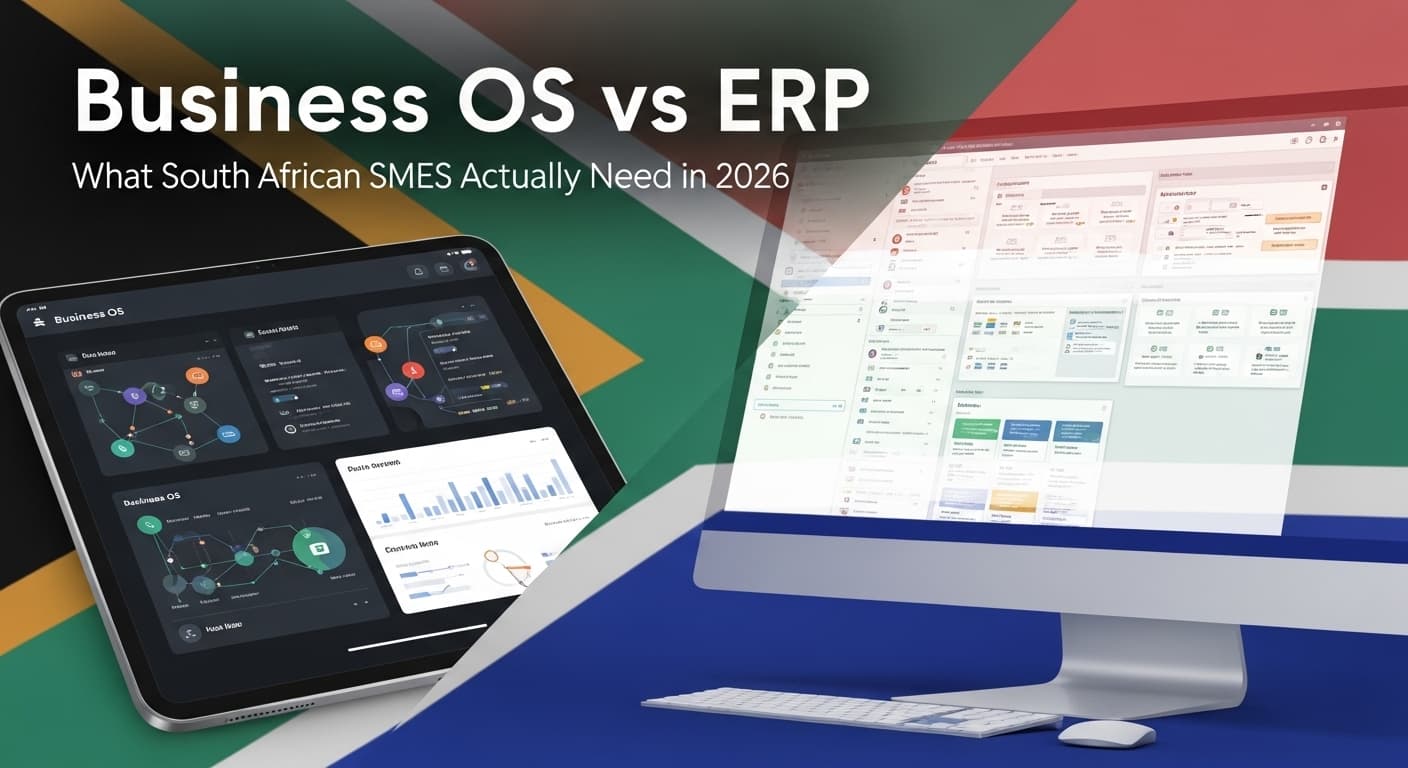
The enterprise software market is crowded with competing acronyms and vendor sales pitches, and South African founders and operations leads feel it more than most. Global vendors push expansive ERPs, standalone CRMs, and separate billing tools, each promising to be the answer.
When a growing business hits an operational ceiling — spreadsheet sprawl, missed client deliverables, the same data keyed in three times — the instinct is to replace the whole stack. But the choice of foundational software matters more than most teams expect: the wrong architecture can slow a growing company down for years and leave it carrying technical debt it never planned for.
For most companies entering their next growth phase, the decision comes down to ERP vs business software: commit significant capital to a traditional Enterprise Resource Planning system, or adopt a modern, more flexible Business Operating System (Business OS)?
This 2026 guide to choosing business management software in South Africa cuts through the jargon, looks at realistic ZAR cost structures, and helps you work out which architecture actually fits how your business runs.
What Exactly Is an ERP? (And Why Was It Built?)
An Enterprise Resource Planning (ERP) system is the traditional heavyweight of corporate software. It was originally built decades ago for large manufacturing organisations, and it's designed to govern complex physical supply chains, global inventory, and hardware production schedules.
Systems like SAP, Oracle, or legacy Sage X3 are built around the idea of end-to-end control. They enforce standardised processes across thousands of employees, and because an ERP touches everything from shipping logistics to factory-floor asset depreciation, it's built for stability rather than speed.
For a multinational mining or logistics operation running heavy inventory across borders, a customised ERP is the right call. But for a digital agency, a scaling consultancy, or a B2B service firm, an ERP is usually an expensive constraint — it adds process where those businesses need agility.
What Is a Business OS?
A Business Operating System (Business OS) is a more modern take on the same goal, without the manufacturing-era weight. It's a unified platform built specifically for service businesses, agencies, and fast-moving teams whose main asset is their people rather than physical stock.
Instead of forcing your company to adapt to factory-floor mechanics, a Business OS aligns the three things a service business actually runs on: the sales pipeline (CRM), delivery and execution (project management), and financial health (invoicing and billing).
Syniq Business OS is a South African example of exactly this architecture. When a sales lead closes a deal in the CRM, the project dashboard populates and a SARS-compliant deposit invoice is triggered for finance — without anyone re-entering the details. It delivers the "single source of truth" that ERPs have long promised, but through a modern, responsive interface that teams are willing to use every day.
Core Differences: The Realities of ERP vs Business Software
Looking at ERP vs business software in practice, the differences are significant, and they're often shaped by the realities of the local South African market.
Cost and ZAR pricing: Legacy ERPs are capital-intensive. Licensing and the customisation work they require routinely start above R1 million and can climb into the tens of millions of rand, before the external consultants needed to deploy them. A Business OS runs on transparent SaaS pricing instead: a predictable monthly ZAR subscription that scales with your user count, which removes the large upfront capital outlay. You can see how that looks on the Syniq pricing page.
Deployment and implementation timelines: A traditional ERP rollout in South Africa typically runs 12 to 24 months, with stakeholder workshops, custom development, and operational downtime along the way. A Business OS is designed for faster deployment — with well-built APIs and sensible defaults, most teams are migrated, trained, and live within weeks rather than months.
Flexibility and local support: ERPs resist change. If your model shifts — say, from project-based billing to monthly retainers — reconfiguring a traditional ERP means consultants and weeks of rework, and Tier-1 support is often routed through overseas call centres. A Business OS adapts to new revenue models without custom code, and working with a local team means same-timezone support that understands local realities, from load-shedding-resilient cloud architecture to SARS VAT compliance.
Diagnosing Your Software Requirements
Choosing between an ERP and a Business OS comes down to how your business actually operates. This quick framework helps:
An ERP fits if: You run a heavy-production manufacturer, a multi-port freight logistics operation, or a hardware supply chain. You hold significant physical inventory tracked to individual barcodes across jurisdictions, you need specialised factory compliance tracking, and you have the capital to absorb a multi-year implementation.
A Business OS fits if: You run a B2B consultancy, a design agency, a professional services firm, or a sales-led team. You don't manufacture physical goods — your "inventory" is your team's billable time, expertise, and client relationships. You need fast daily workflows, an integrated CRM and pipeline, unified project delivery, and automated SARS-compliant billing, all usable without an accounting degree.
The Case for a Unified Platform Over Point Solutions
Before adopting a Business OS, many SME founders fall into the "SaaS trap": stitching together isolated point solutions. That often means HubSpot for CRM, Monday.com or Asana for projects, Xero for accounting, and Slack for communication.
It feels agile early on, but as you scale, a fragmented stack creates data silos and manual errors. Teams end up spending more billable hours managing brittle integrations between tools than serving clients — and the combined cost of overlapping, USD-priced subscriptions quickly overtakes a single unified platform.
A Business OS removes that friction. By centralising operational data, it gives leadership accurate, real-time visibility — so you can forecast revenue, track project profitability, and scale without growing your admin payroll to keep up.
Conclusion
The conversation around business management software in South Africa has shifted. Heavily customised global ERPs still make sense for large heavy-industry manufacturers, but putting a modern service-based SME into a rigid, million-rand ERP is an expensive and avoidable mistake.
For most growing service businesses, the Business OS is the better fit. It provides the data unification of an enterprise system without the rollout cost, operational friction, or dated interfaces of the past.
If your team is tired of fighting disconnected tools, it may be time to consolidate. Talk to us about what a unified Business OS would look like for your operation.