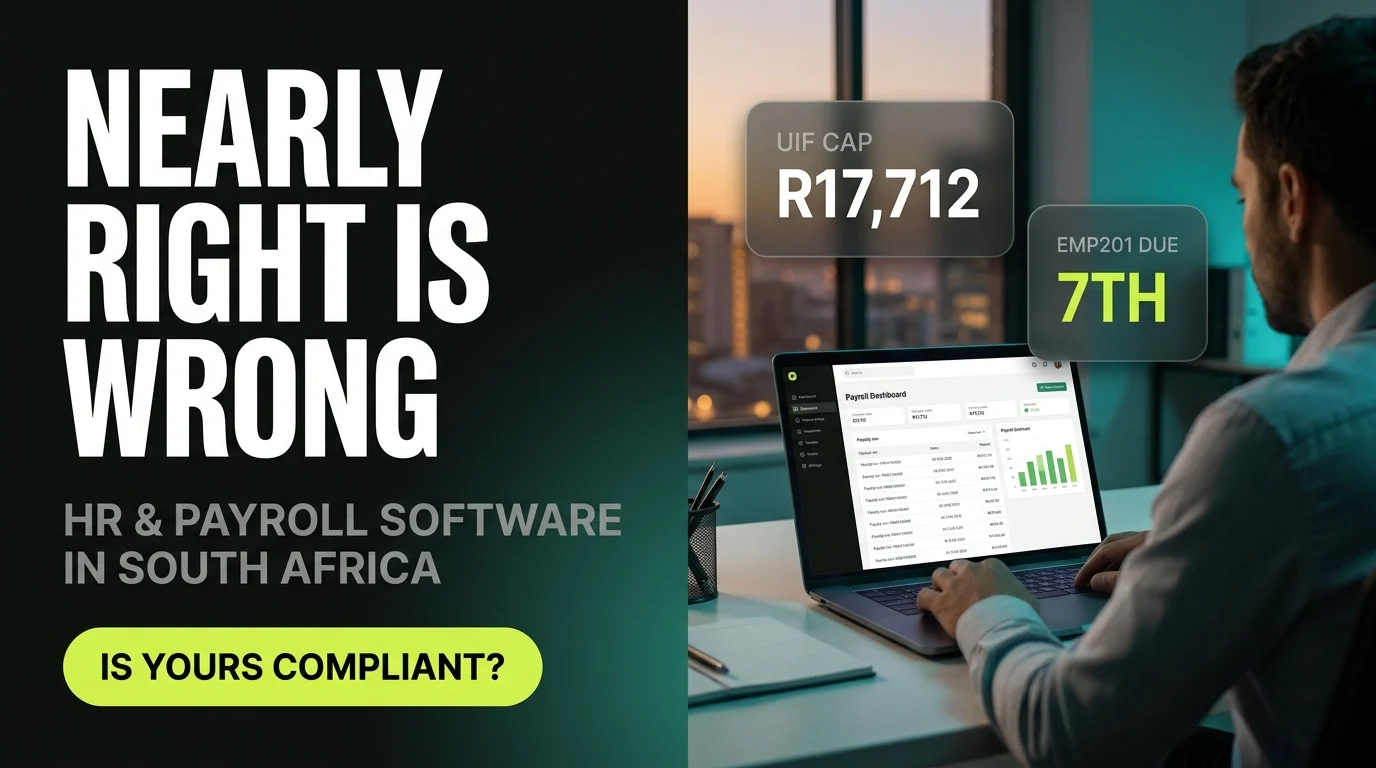
Payroll software for a South African business has to do four things without you thinking about them: calculate PAYE, UIF and SDL correctly on every payslip, feed an accurate EMP201 to SARS by the 7th of each month, produce BCEA-compliant payslips, and generate IRP5/IT3(a) certificates at reconciliation. Leave, self-service and reporting are the bonus.
Most business owners choose payroll software the way they choose a kettle — by price and by whoever came up first. Then February arrives, the EMP501 reconciliation doesn't balance, and a week disappears into a spreadsheet nobody trusts.
Payroll is unusual among business systems in that being nearly right is the same as being wrong. A CRM with a stale field costs you a follow-up. A payroll run with the wrong UIF cap costs you a SARS penalty, an unhappy employee, and the afternoon. So the selection criteria are different: you're not buying features, you're buying the certainty that a set of statutory calculations will be correct twelve times a year, every year, as the rules change underneath you.
Here's what to actually check.
What is the difference between HR software and payroll software?
They overlap, but they answer different questions.
Payroll software answers what do we pay this person, and what do we owe SARS? It handles earnings and deductions, tax calculations, payslips, bank payment files, and statutory submissions.
HR software answers who works here, and what's happening with them? Employee records, contracts, leave balances, onboarding, performance, disciplinary history, org structure.
In a small South African business the two are usually sold together, because they share the same spine: an accurate employee record. Where they split is at scale. Once you're past roughly fifty people, HR grows its own requirements — recruitment pipelines, skills matrices, SETA reporting — that a payroll engine was never designed to carry.
The practical rule: never buy HR features at the cost of payroll accuracy. A beautiful leave-request interface is worth nothing if the PAYE calculation behind it needs a manual override every March.
Which statutory deductions must a South African payroll system handle?
This is the non-negotiable list. If a system can't do all of these natively — not via a spreadsheet you maintain on the side — it isn't payroll software for this market.
| Item | Who pays | Rate | Cap or threshold | Where it's declared |
|---|---|---|---|---|
| PAYE | Employee | Sliding scale per the SARS annual tax tables | Annual tax threshold varies by age band | EMP201, monthly |
| UIF | Employee and employer | 1% each (2% combined) | Remuneration capped at R17,712 per month, so a maximum of R177.12 from each side, R354.24 in total | EMP201, monthly |
| SDL | Employer only | 1% of total monthly remuneration | Exempt where total remuneration over the next 12 months will not exceed R500,000 | EMP201, monthly |
| ETI (a credit, not a deduction) | Reduces the employer's PAYE liability | Up to R1,500 per month per qualifying employee in the first 12 qualifying months, R1,000 in months 13–24 | Employees earning R7,500 or more per month do not qualify (values effective 1 April 2025); the incentive runs to 28 February 2029 | EMP201, monthly |
Two details catch people out. The UIF ceiling has sat at R17,712 per month since 1 June 2021 — it is a remuneration cap, not an earnings threshold, so a R60,000-a-month employee still contributes, just on R17,712. And SDL exemption is forward-looking: it's based on what you expect to pay over the coming twelve months, which means a growing team can cross the line mid-year and owe SDL before anyone notices.
If your payroll system doesn't recalculate that automatically, you're carrying the risk personally.
What SARS deadlines should your payroll software protect you from?
Compliance isn't only about calculating correctly. It's about calculating correctly on time, in a format SARS accepts.
- EMP201 — monthly. Due by the 7th of the following month, covering PAYE, UIF and SDL, less any ETI claimed. Where the 7th falls on a weekend or public holiday, it moves earlier, not later.
- Interim EMP501 reconciliation. Covers 1 March to 31 August, submitted in the September–October window each year.
- Annual EMP501 reconciliation. Covers the full tax year to end-February, with the submission season running 1 April to 31 May.
- IRP5/IT3(a) certificates. Generated as part of the EMP501 and submitted via e@syFile or eFiling. These are what populate your employees' own tax returns — get them wrong and the problem lands on every staff member at once.
- BCEA payslips and records. Section 33 requires a payslip each time an employee is paid; employee records under section 31 must be kept for at least three years after the last entry.
Good payroll software makes these dates boring. It produces the EMP201 figures without a reconciliation exercise, exports directly to e@syFile, and keeps three years of payslip history retrievable in seconds rather than in a folder on someone's laptop.
That last point matters more than it sounds. Most payroll pain in small businesses isn't calculation error — it's retrieval failure. The number was right in April. Nobody can prove it in November.
Running payroll on spreadsheets and hoping February goes smoothly? Book a no-obligation discovery call and we'll map your current process end to end — no pitch, just a clear picture of where the risk sits.
How much does payroll software cost in South Africa?
South African payroll products almost all price the same way: a base subscription plus a per-employee-per-month rate, quoted excluding VAT. Many publish a live quote calculator rather than a fixed price list, because the number moves with headcount every month.
Indicative bands, to set expectations before you start getting quotes:
| Team size | Typical model | Indicative monthly range (ex VAT) | What you're getting |
|---|---|---|---|
| 1–10 employees | Base fee + per-employee | Low hundreds of rands | Core payroll, payslips, EMP201 figures, IRP5 export |
| 10–50 employees | Base fee + per-employee, tiered | Several hundred to low thousands | The above, plus leave management and employee self-service |
| 50–200 employees | Negotiated per-employee rate | Low to mid thousands | Adds approval workflows, integrations, deeper reporting |
| 200+ employees | Enterprise agreement | Quoted per organisation | Multi-entity, multi-currency, custom reporting, dedicated support |
These are indicative ranges to help you budget, not quotes. Actual pricing depends on headcount, pay frequency, how many pay runs you process, and whether you need implementation and data migration. Ask every vendor for a written quote against your real employee count — and book a scoping call if you want a fixed figure for anything custom.
The number that actually matters isn't the subscription. It's the total cost of a pay run: subscription, plus the hours your finance lead spends reconciling, plus the cost of the errors that slip through. A R400-a-month product that consumes six hours of senior time every month is not cheap. Price the labour, not the licence.
Should you buy payroll software, use a bureau, or build it in?
Three viable paths, and the right one depends less on your size than on how unusual your pay rules are.
| Approach | Best for | Strengths | Watch-outs |
|---|---|---|---|
| Spreadsheet | Under five employees, simple salaries, short term | No licence cost, complete flexibility | No audit trail, manual tax-table updates, breaks the moment someone leaves mid-month |
| Off-the-shelf payroll product | Most SMEs with standard salaried or hourly staff | Statutory updates handled for you, fast to start, well-supported | Limited flexibility for unusual pay rules; data lives in a separate silo from the rest of your business |
| Payroll bureau (outsourced) | Businesses with no finance capacity, or complex bargaining-council rules | Expertise on tap, compliance risk shared | Slower turnaround on changes; you depend on their calendar, not yours |
| Integrated into your business system | Businesses where pay depends on operational data — hours, jobs, commission, production | One source of truth; pay is calculated from the work actually recorded | Higher upfront investment; payroll engine must still meet every statutory requirement |
The fourth row is where most of the interesting pain lives. If your team is paid on billable hours, completed jobs, delivery counts or commission, then payroll is downstream of operations — and every month someone exports data from one system, reshapes it in Excel, and imports it into another. That handoff is where errors are born.
That's the case for connecting payroll to the system that already holds the operational truth. Syniq's Business OS keeps sales, operations, finance and support on one data spine, so the numbers that drive pay — hours logged, jobs closed, deals won — are already in one place when you prepare the payroll run. Our tax-compliant invoicing and accounting module sits on that same spine, and the executive dashboard reads from it directly rather than from a monthly export. You can see how it's priced on the Business OS pricing page.
Where the pay rules are genuinely unique to your industry, custom software is the honest answer — built around your rules rather than forcing your rules into someone else's fields.
What does POPIA require of your payroll data?
Payroll is the most sensitive data set in most businesses. ID numbers, tax numbers, bank details, salary, medical aid, sometimes disciplinary records. Under POPIA this is personal information, and some of it is special personal information.
Four things to verify before you commit to any system:
- Where is the data hosted, and who can reach it? Ask for the answer in writing. "The cloud" is not an answer.
- Is access restricted by role? Not everyone who uses HR features should see salaries. Field-level permissions matter here in a way they don't elsewhere.
- Is there an audit trail? You need to be able to show who changed a bank detail and when. This is also your best defence against payroll fraud, which almost always starts with a quiet banking-detail change.
- What happens at the end? Retention and deletion policies must let you meet the BCEA's three-year record requirement without holding data indefinitely.
We've written up how we approach this in our POPIA commitment. The short version: employee data should be treated as the most protected data in the building, because it is.
How do you know it's time to move off spreadsheets?
You don't need a formal assessment. Four signals are enough:
- One person is the system. If payroll can't run while someone is on leave, you don't have a process, you have a dependency.
- The reconciliation is an event. If EMP501 season means a week of evenings, the monthly numbers aren't trustworthy — the reconciliation is doing work the payroll run should have done.
- Employees ask you for their payslips. Retrieval should be self-service. If it isn't, you're the archive.
- You're rekeying operational data. Hours, commission or job counts moving between systems by copy-paste is a defect waiting for a busy month.
Any two of these and the subscription cost of proper payroll software is already smaller than what you're paying in time and risk.
The bottom line
Buy for compliance first, convenience second. A South African payroll system earns its place by handling PAYE, UIF and SDL correctly, filing an accurate EMP201 by the 7th, producing BCEA-compliant payslips, generating clean IRP5/IT3(a) certificates, and protecting employee data to POPIA standards. Everything after that is preference.
The bigger question is whether payroll should sit on its own island. If what you pay people depends on what your business actually did that month, then payroll belongs connected to operations — not downstream of an export.
Ready to connect pay to the work that earns it? Book a no-obligation discovery call. We'll look at how your pay data moves today, where it's rekeyed, and what it would take to connect it properly — whether that ends in Business OS, a custom build, or simply a better-configured version of what you already have.
Frequently asked questions
Does payroll software have to be "SARS-approved" in South Africa? SARS does not certify or approve payroll software. What matters is that the system produces accurate PAYE, UIF and SDL calculations, generates a correct EMP201, and exports IRP5/IT3(a) certificates in a format e@syFile and eFiling accept. Responsibility for accuracy stays with the employer, not the vendor.
What is the difference between HR software and payroll software? Payroll software calculates pay and statutory deductions and handles SARS submissions. HR software manages the employment relationship — records, leave, onboarding, performance. Most South African SME products bundle both, but payroll accuracy should always be the deciding factor.
Does payroll software calculate UIF and SDL automatically? Any credible South African product does. UIF is 1% from the employee and 1% from the employer, calculated on remuneration capped at R17,712 per month. SDL is 1% of total monthly remuneration, payable by employers whose total remuneration over the next 12 months will exceed R500,000. Both are declared on the monthly EMP201.
How much does payroll software cost in South Africa? Most products charge a base subscription plus a per-employee-per-month rate, excluding VAT, so the cost scales with headcount. A small team typically sits in the low hundreds of rands per month; larger organisations move to negotiated per-employee rates. Always request a written quote against your actual employee count.
Can I still run payroll on a spreadsheet? Legally, yes — the BCEA requires compliant payslips and three years of records, not specific software. Practically, spreadsheets fail on audit trail, tax-table updates and retrieval. Once you're past a handful of employees, or once pay depends on variable hours or commission, the risk outweighs the saving.
Is employee payroll data covered by POPIA? Yes. Salaries, ID numbers, tax numbers and banking details are personal information under POPIA, and some payroll data qualifies as special personal information. Employers must restrict access by role, maintain an audit trail of changes, and apply defined retention and deletion policies.
Written by Mikhail for Syniq (Pty) Ltd. Syniq is a Cape Town software company building Business OS and custom software for growing South African businesses. This article is general guidance, not legal, tax or payroll advice — confirm your own SARS, BCEA and POPIA obligations with your accountant or attorney. Statutory figures were verified in August 2026 and change with each Budget; pricing bands are indicative only.