Contract management software stores every signed agreement in one searchable place and tracks what happens after signature — renewal dates, price escalations, notice periods and obligations. South African businesses use it to stop contracts auto-renewing unnoticed, to meet POPIA and Companies Act record-keeping duties, and to find any clause in seconds instead of hours.
Most businesses treat signature as the finish line. It isn't. It's the moment the meter starts running — and the moment almost everyone stops paying attention.
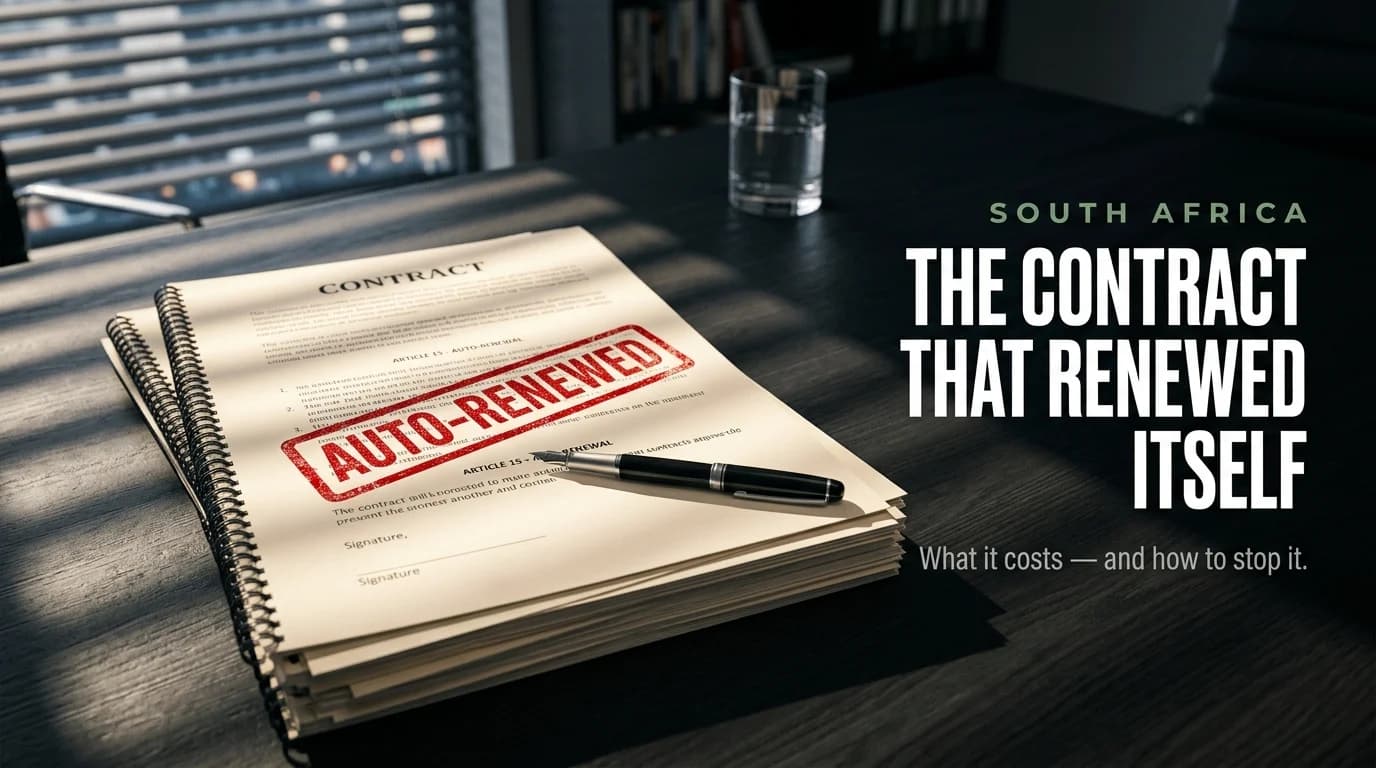
The contract goes into a shared drive, or an inbox, or a lever-arch file in the storeroom. Eighteen months later nobody can find it, the escalation clause quietly added 9% to a monthly fee, and the supplier agreement renewed for another year because the cancellation window closed three weeks ago. None of that is a legal failure. It's a filing failure with a price tag.
What is contract management software?
Contract management software — often called contract lifecycle management, or CLM — is a system that carries an agreement from first draft through to renewal or exit. A working setup handles five things:
- Templates and drafting. Approved clause libraries so the same agreement doesn't get rewritten differently by three people.
- Approval routing. Who signs off before it goes out, in what order, recorded automatically.
- Signature. Electronic signing with an audit trail of who signed what, when, and from where.
- A searchable repository. Full-text search across every executed agreement, with the metadata that matters extracted — parties, value, start date, end date, notice period.
- Obligation and renewal tracking. Automatic reminders before a notice window closes, and a register of what each party actually promised to do.
The first three are the visible part. The last two are where the money is.
Why do businesses lose money on contracts they already signed?
Because commercial attention drops off exactly when the commitment begins.
Research from World Commerce & Contracting puts average contract value erosion at roughly 8.6% — with the best-performing organisations holding it a little above 3%, and the weakest exceeding 20%. Other studies across procurement functions have landed near 11% of contracted spend. The causes are unglamorous and consistent: missed savings that were negotiated but never claimed, unrecorded scope changes, and renewals that happen by default because nobody diarised the notice date.
Scale that down to a South African SME with R12 million in annual supplier and client commitments, and even the best-in-class 3% figure is R360,000 a year. At the weaker end of the range it's over R2 million. You will not find that money on an income statement line called "poor contract admin". It hides inside cost of sales, inside subscription creep, inside a debtor who disputed a deliverable you can no longer prove was agreed.
Which contracts can be signed electronically in South Africa?
Almost all of them. The Electronic Communications and Transactions Act 25 of 2002 (ECTA) puts electronic signatures on the same legal footing as ink for ordinary commercial agreements, and electronic contracts are admissible as evidence.
There are narrow exclusions. Section 4(3), read with Schedule 1, carves out:
| Document type | Governing statute | Can it be e-signed? |
|---|---|---|
| Ordinary commercial contracts, SLAs, NDAs, employment contracts | ECTA | Yes |
| Wills and codicils | Wills Act 7 of 1953 | No |
| Sale or alienation of immovable property | Alienation of Land Act 68 of 1981 | No |
| Long-term leases of immovable property (10 years or more) | ECTA Schedule 1 | No |
| Bills of exchange | Bills of Exchange Act 34 of 1964 | No |
Where a statute specifically requires a signature — as opposed to simply contemplating one — ECTA calls for an advanced electronic signature, which must be issued by an accredited authentication service provider. For day-to-day commercial contracting, an ordinary electronic signature with a solid audit trail is sufficient and enforceable.
One local rule catches suppliers out regularly. Section 14 of the Consumer Protection Act governs fixed-term consumer agreements: the term generally may not exceed 24 months, the supplier must notify the consumer of impending expiry between 80 and 40 business days beforehand, and the consumer may cancel on 20 business days' written notice. It does not apply to agreements between juristic persons. If you sell to individuals or sole proprietors on fixed terms, that 40-to-80-business-day notification window is not something to manage by memory — it is exactly what an automated reminder exists for.
How long must you keep a signed contract?
Longer than most businesses assume, and the answer comes from several statutes at once.
| Requirement | Source | Period |
|---|---|---|
| Company records, accounting records, resolutions | Companies Act 71 of 2008, s24 | 7 years minimum |
| Tax and VAT supporting records | Tax Administration Act / VAT Act | 5 years from return submission |
| Most contractual debts (claim window) | Prescription Act 68 of 1969, s11(d) | 3 years from when the debt fell due |
| Personal information inside the contract | POPIA, s14 | No longer than necessary, unless required or authorised by law or contract |
The two ends of that table pull against each other, and that tension is the whole point. The Companies Act sets a floor; POPIA sets a ceiling on the personal information inside those records. Where periods overlap, the safe practice is to apply the most stringent retention obligation and then delete deliberately — not to keep everything forever "just in case", which is precisely the habit POPIA was written to break.
A shared drive cannot do this. It has no concept of a retention clock, no way to flag which records are past their lawful life, and no audit trail when someone deletes the wrong folder. A proper repository can. If you're still mapping your obligations, our POPIA approach sets out how we handle personal information in the systems we build.
Not sure which of your agreements are quietly renewing? A 30-minute discovery call is usually enough to map where your contracts live and what's slipping. No obligation, no pitch deck.
What does contract management software cost in South Africa?
Most CLM vendors are international and price in dollars, which means your cost moves with the rand. The ranges below convert at roughly R16 to the dollar and are indicative only — published pricing is scarce at the upper tiers, where quotes are built around contract volume, user count and integration scope.
| Tier | What you get | Indicative cost (ZAR) |
|---|---|---|
| Shared drive + spreadsheet | Storage. No reminders, no audit trail, no retention control. | R0 licence, high hidden admin cost |
| E-signature only | Signing and audit trail. No repository intelligence or renewal tracking. | ~R160–R650 per user / month |
| Mid-market CLM | Repository, metadata extraction, approvals, renewal alerts. | ~R8,000–R25,000 / month, entry configurations |
| Enterprise CLM | AI clause analysis, deep ERP/CRM integration, complex approval matrices. | R300,000–R3,000,000+ / year, plus implementation |
| Contract module inside an operations platform | Contracts sitting alongside the CRM, invoicing and support records they relate to. | Bundled with the platform subscription |
| Custom-built contract workflow | Built to your exact approval chain, sector and compliance rules. | Scoped per project |
Two things are worth saying plainly. First, enterprise CLM pricing is built for legal departments with dedicated contract managers — for a 20-person Cape Town agency, the licence alone can exceed the value being protected. Second, implementation is frequently the larger number: migrating and tagging a decade of legacy agreements is real work, and vendors rarely lead with it.
We don't publish a single figure for custom work because the honest answer depends on what you're automating. Book a scoping call and you'll get a fixed quote against a defined scope.
Dedicated CLM tool, or a contract module in your operations platform?
This is the real decision for most South African SMEs, and the answer turns on where the pain sits.
| Choose a dedicated CLM when | Choose a contract module in your ops platform when |
|---|---|
| Contracts are your core commercial risk (construction, insurance, large-scale procurement) | Contracts are one of several workflows you're trying to get under control |
| You have hundreds of active agreements with complex clause variation | You have tens to low hundreds of fairly standard agreements |
| A legal or contract manager owns the process full-time | Ops, finance or the owner manages contracts alongside other duties |
| You need clause-level AI analysis and negotiation redlining | You need the contract to be findable, monitored, and linked to the client record |
| Integration budget exists to connect it to everything else | You'd rather not add a fourth system that needs syncing |
The second column describes most growing businesses. A contract that lives beside the deal that produced it, the invoices raised against it and the support tickets logged under it is more useful than a contract sitting in a specialist silo — because the questions you actually ask are cross-functional. Is this client profitable at the rate we agreed? Did we deliver the SLA we promised before we renew?
That's the logic behind how contracts are handled in Syniq Business OS: the agreement is attached to the client record in Sales & CRM, the accepted quote becomes the tax-compliant invoice, and contract renewal dates sit on a renewals board of their own rather than in a diary entry someone forgot to make.
Where an off-the-shelf module genuinely can't model your approval chain — regulated sectors, multi-entity sign-off, sector-specific clause rules — that's a case for custom software instead.
What features actually matter for a South African SME?
Cut through the feature lists. These six earn their place:
- Full-text search across executed documents. If you can't find a clause in under a minute, nothing else matters.
- Renewal and notice-period alerts, with an owner assigned. An alert nobody owns is an email nobody reads.
- Extracted metadata on every contract. Counterparty, value, start, end, notice window, escalation rate.
- Audit trail on signature and every subsequent version. This is your evidence if a dispute reaches prescription.
- Retention rules that map to South African statute. Seven years where the Companies Act applies, defensible deletion after.
- Data residency and access control you can explain. POPIA makes you accountable for who can see what, wherever it's hosted.
Anything beyond those is refinement. Buy the refinement later.
How do you roll it out without losing three months?
Don't migrate everything. It's the mistake that stalls most implementations.
- Week 1 — Inventory the live ones only. Every agreement currently in force. Ignore the archive for now.
- Week 2 — Tag the four fields that matter. Counterparty, end date, notice period, annual value. Nothing else yet.
- Week 3 — Turn on alerts and assign owners. Every contract gets a named person. This alone stops most silent renewals.
- Week 4 — Standardise going forward. New agreements enter the system properly from day one.
- Ongoing — Backfill the archive. In slow weeks, in date order, newest first.
By the end of the first month you've closed the leak. The archive is housekeeping, and housekeeping can wait.
The short version
Signature isn't the end of a contract; it's the start of the part where value is won or quietly lost. You don't need enterprise CLM to fix that. You need every live agreement in one searchable place, four fields tagged, a named owner, and an alert that fires before the notice window closes.
If your contracts are currently spread across a shared drive, three inboxes and someone's memory, book a discovery call. We'll map where they live and what it would take to bring them together — either inside Business OS or as a custom workflow built around how your business actually signs things.
Frequently asked questions
Is a WhatsApp or email exchange a binding contract in South Africa? It can be. South African law generally requires no particular form for most commercial contracts, and ECTA recognises data messages. If offer, acceptance and the intention to be bound are present, a written agreement may exist even without a formal document — which is another reason to keep negotiations in a system that records them.
Do I need an advanced electronic signature for supplier contracts? Usually not. An advanced electronic signature is required only where a statute specifically demands a signature. Ordinary commercial agreements, NDAs and SLAs can be signed with a standard electronic signature backed by an audit trail.
How long should I keep a contract after it ends? Apply the longest applicable obligation. Companies Act records run seven years, tax records five, and most contractual claims prescribe after three. Then, under POPIA, delete the personal information inside them once no lawful basis to retain it remains.
Can contract management software stop automatic renewals? It can't cancel on your behalf, but it removes the reason renewals slip — it tells a named owner before the notice window closes. For fixed-term consumer agreements under the Consumer Protection Act, that window is 80 to 40 business days before expiry.
Is a spreadsheet ever enough? Under roughly 20 active agreements with a disciplined owner, yes — for a while. The failure point is rarely volume; it's staff turnover. When the person who maintained the sheet leaves, the institutional memory leaves with them.
Should a small business buy CLM software or build a contract workflow? Buy if your process is standard and a module in a platform you already run covers it. Build if your approval chain, sector rules or compliance obligations don't fit any off-the-shelf model — and the manual workaround is costing more than the build.
This article summarises publicly available South African legislation — ECTA, the Consumer Protection Act, the Companies Act, the Prescription Act and POPIA — as at September 2026. It is not legal advice; Syniq is a software company. Confirm your own position with an attorney.