Project management software helps South African teams plan work, assign people, track time and cost, and bill accurately. Choosing well comes down to three questions: does it price and invoice in rand, does it connect to your CRM and finance, and does it keep working when your connectivity doesn't? Features matter less than those three answers.
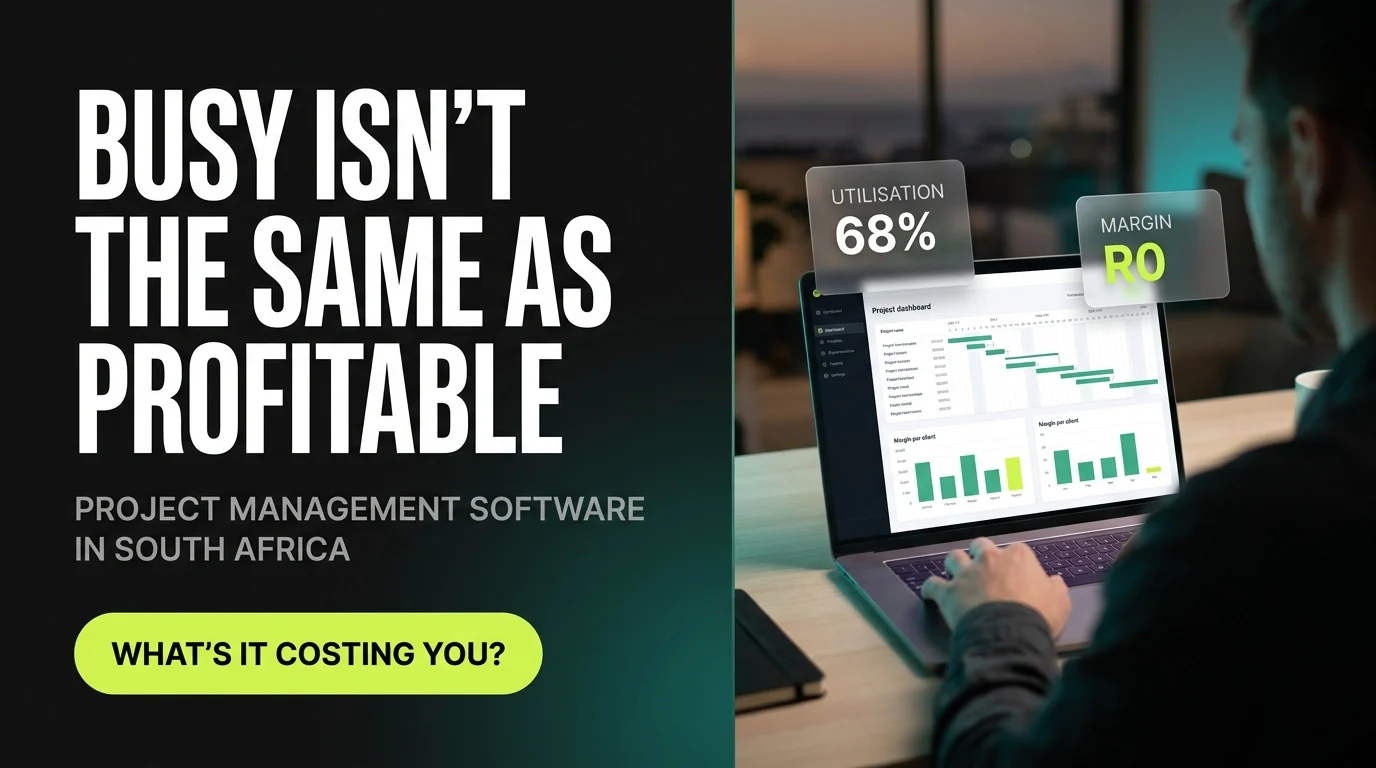
Most South African service businesses do not have a project management problem. They have a visibility problem that shows up as one.
The symptom is familiar. A retainer that felt profitable in January is quietly bleeding by June. A designer is double-booked and nobody notices until a deadline slips. An invoice goes out three weeks late because the job was finished but never closed off. That isn't a planning failure — it's a measurement failure. The work happened; the business just couldn't see it in time to act.
What does project management software actually do?
Four things. Everything else vendors advertise is a variation on these.
It holds the plan. Projects, phases, tasks, deadlines, dependencies — one place where "what happens and by when" lives, instead of six WhatsApp groups and a shared spreadsheet.
It allocates the people. Who is working on what, this week and next. This is where most agencies leak money — not on the projects they can see, but on the capacity they can't.
It records the cost. Hours, materials and subcontractors logged against a budget, in real time rather than at month-end when the loss is already booked.
It closes the loop to billing. Completed work becomes an invoice without someone re-typing it. Most tools skip this step, and it's the one that determines whether the software pays for itself.
A tool that only does the first two is a planning board. Useful — but it won't tell you whether you're making money.
Why do South African businesses need different selection criteria?
Most project management software is built in the United States for teams that bill in dollars, run on fibre, and never think about SARS. Four things change the calculation locally.
Currency exposure. If a tool is priced in USD, your software bill moves with the rand. At roughly R16.20 to the dollar in mid-August 2026, a $12 seat costs about R195. Budgeting a core operational system in a currency you don't earn in means your costs are set by the foreign exchange market rather than by your own growth.
VAT on imported software. Foreign suppliers of electronic services that meet SARS's registration threshold must register as South African VAT vendors and charge 15% on local supplies. If you're a registered vendor you'll claim it back; if you're not, it's a real 15% increase on every seat.
POPIA obligations. Your project system holds client contacts, staff records and commercially sensitive material belonging to your customers. Under the Protection of Personal Information Act you remain the responsible party for that data regardless of where the vendor stores it. Get clear answers on hosting location, cross-border transfer, and how you export everything if you leave.
Power and connectivity. A cloud tool that needs a live connection to log a job is a tool your field team will stop using. Offline-first capture — work recorded locally, synced when the connection returns — is the difference between accurate timesheets and reconstructed guesswork.
How much does project management software cost in South Africa?
Vendor list prices are quoted per user per month, usually on annual billing, and usually excluding VAT. Here's what the common options work out to for a small team, converted at approximately R16.20 to the dollar.
| Option | Published list price | Approx. monthly cost, 5-seat team | Billed in | Notes |
|---|---|---|---|---|
| ClickUp (Unlimited) | $7 / user / mo, annual | ≈ R565 | USD | Rises to $10 / user on monthly billing |
| monday.com (Standard) | $12 / seat / mo, 3-seat minimum | ≈ R970 | USD | Seats sold in blocks; Pro tier $19 |
| Asana (Starter) | $10.99 / user / mo, 2-seat minimum | ≈ R890 | USD | $13.49 / user on monthly billing |
| Local PMO platforms | Varies; some flat-rate | Varies | ZAR | Flat pricing removes per-seat scaling |
| Syniq Business OS (Business) | R559 / mo, annual | R559, 5 users included | ZAR | All six apps, up to 5 users |
| Custom-built system | Project-based | — | ZAR | One-off build, no recurring licence |
All figures are indicative as at August 2026, exclude VAT (Syniq is not VAT-registered, so none is added to its price), and exclude implementation, migration and training. Exchange rates and vendor pricing change. For a fixed number against your actual team size and workflow, book a scoping call.
Two things stand out.
Per-seat pricing punishes growth. A five-person team on a $12 seat pays roughly R970 a month. At fifteen people it's about R2,900 — for the same software, doing the same thing. Flat or bundled pricing changes the shape of that curve entirely.
And licence cost is rarely the largest number. Migration, configuration, and the weeks your team spends half-productive on a new system routinely exceed the first year's subscription. Ask any vendor what implementation actually looks like before you compare monthly figures.
Which features actually change profitability?
Most features you can compare don't move the number. These four do.
Real-time job costing. Labour, materials and subcontractor spend logged against a budget while the job is running. Without it, you discover unprofitable work at month-end — after you can no longer do anything about it. This is the highest-leverage feature for a service business, and the one most generic task tools omit.
Resource and capacity planning. SPI Research's 2025 Professional Services Maturity Benchmark recorded billable utilisation across surveyed firms falling to 68.9%, the lowest reading since 2019, alongside average EBITDA of 9.8%. Agencies typically run lower still — 55–65% blended — because pitching, admin and internal work are real but unbillable. You cannot improve a number you don't measure weekly.
Scope and change control. PMI's Pulse of the Profession research found 52% of projects experience scope creep, up from 43% five years earlier. Software won't stop a client asking for more. It will make the ask visible, timestamped, and attached to a change order rather than absorbed silently into someone's evening.
A clean handoff to invoicing. When a milestone completes, an invoice should be waiting for approval — VAT applied, line items itemised. Delayed billing is a cash flow problem wearing a project management costume. Syniq's Finance module handles SARS-compliant invoicing directly off completed operational work.
A tool that can't do those four is a coordination tool. Useful for keeping a team aligned. Not a system for running a business.
Standalone tool or connected platform?
This is the decision that matters most, and it's usually made by accident.
A standalone project tool is fast to adopt and genuinely good at what it does. The cost arrives later, in the form of seams. Leads live in a CRM. Projects live in the project tool. Invoices live in accounting software. Support tickets live somewhere else again. Every seam is a place where data gets re-typed, goes stale, or contradicts itself — and every seam needs a human to maintain it. We've covered the hidden cost of disconnected business tools before: the subscriptions are visible, the integration labour isn't, and the invisible number is almost always the bigger one.
A connected platform trades some best-in-class depth for a single source of truth. A won deal becomes a project automatically. Hours logged flow into the invoice. The invoice flows into the executive dashboard, where you see margin by client without exporting anything to Excel.
Syniq Operations is built on that principle — jobs in list, Kanban and Gantt views, tasks with logged hours and contract renewals, linked to sales, finance and support. If you're weighing it against a per-seat work platform, the Syniq vs monday.com comparison lays out the differences.
The honest version of the trade-off: if project management is genuinely the only thing you need software for, buy the specialist tool. If projects are one of six things your business does and they all touch each other, the seams will cost you more than the feature gap.
Not sure which side of that line you're on? A 30-minute discovery call will tell you — no pitch, no obligation. Book a call with our team.
When is custom project management software worth building?
Most of the time it isn't, and any development company that tells you otherwise is selling rather than advising. Off-the-shelf software wins when your process resembles everyone else's. Building something bespoke to replicate what a R559-a-month subscription already does is an expensive way to own a maintenance burden.
Custom becomes the right answer in three situations:
Your workflow is the product. If the way you run projects is your competitive advantage — a proprietary methodology, an unusual approval chain, a regulated process — bending it to fit generic software erodes the thing that makes you worth hiring.
You need deep integration with something specific. A legacy ERP, an industry system, specialised equipment, a client's own platform. When the integration is the requirement, it determines the build.
Per-seat costs have outgrown the build. At scale the arithmetic flips. A team of eighty at R400 per seat per month spends north of R380,000 a year on licences alone. Against a one-off build plus maintenance, that comparison stops being obvious.
There's a pragmatic middle path too: run a platform for standard operational work, and build custom only for the workflow that's genuinely yours. Our custom software team works this way often — Next.js, TypeScript, Supabase and PostgreSQL, built in Cape Town with weekly demos and no offshore handoffs.
How should you choose? A five-step process
1. Write down the decision you can't currently make. Not "we need better project management" — something specific, like "I can't tell which clients are profitable." That sentence is your requirement. Everything else is a feature.
2. Map the workflow end to end. Lead → quote → project → delivery → invoice → support. Mark every point where information is re-typed by a human. Those are the seams your software should close.
3. Price it in rand, at your size in two years. Include VAT, the seats you'll add, implementation and migration. Compare that total, not the headline per-seat figure.
4. Test it under real conditions. Run a live project through the trial, not a demo dataset. Include your least technical team member. Test what happens when the connection drops mid-capture — adoption failures kill more rollouts than feature gaps do.
5. Check the exit before the entrance. Can you export your complete data, in a usable format, without paying for the privilege? A confident vendor answers immediately. Hesitation is the answer.
Work through those five and the shortlist usually collapses to two options with the trade-off stated plainly. That's a decision you can make.
Frequently asked questions
What is the best project management software for a small business in South Africa? There isn't a single best one — it depends on whether you need standalone project tracking or a connected operation. If projects are your only software need, a specialist tool like ClickUp or Asana is sufficient. If projects connect to quoting, invoicing and support, a platform covering all of it in rand costs less and breaks less. Syniq Business OS starts at R47 per month for solo operators.
How much does project management software cost in South Africa? Roughly R100–R320 per user per month for international tools on annual billing, before 15% VAT and exchange rate movement. Bundled local options such as Syniq's Business tier start at R559 per month for five users, with no VAT added (Syniq is not VAT-registered). Implementation and migration typically cost more than the first year's licence. See the full pricing breakdown for current figures.
Do I pay VAT on foreign project management software? Generally yes. Foreign suppliers of electronic services exceeding SARS's registration threshold must register as South African VAT vendors and charge 15% on local supplies. Registered vendors can claim the input tax; if you're not registered, it's a straight 15% increase in cost. Confirm your position with your accountant.
Does project management software work during load-shedding? Only if it is built to. Cloud tools that need a live connection to save work fail during an outage, and teams stop capturing data rather than fight the tool. Look for offline-first capture — work stored locally on the device, synced automatically once connectivity returns. Syniq Operations needs a connection, so plan for backup power or mobile data if your team works through outages.
Can project management software integrate with my accounting system? Most offer some integration, but depth varies enormously — a one-way contact sync is not the same as job costs flowing into your P&L. The most reliable arrangement is a platform where projects and finance share one database rather than exchanging files. Ask any vendor to demonstrate a completed job becoming a VAT-compliant invoice, live, during the trial.
Should agencies use project management software or agency management software? Agency management software is project management plus the commercial layer — retainers, client profitability, utilisation and billing. If you sell time and deliverables, you need that layer; a task board alone keeps your team organised while margins erode unnoticed. Syniq's platform for agencies is built around that distinction.
The bottom line
Project management software earns its keep where planning meets money. Anything that helps your team see what's happening while there's still time to change it is worth paying for. Anything that just makes the chaos look tidier is an expense.
Ask the four questions that matter — can it cost a job in real time, plan capacity, control scope, and produce an invoice — then price the answer in rand at the size you intend to be. The rest is preference.
Ready to see what your projects are actually earning? Book a free discovery call and we'll map your workflow, show you where the leaks are, and tell you honestly whether you need a platform, a custom build, or neither.
Written by Mikhail for Syniq (Pty) Ltd. Syniq is a Cape Town software company building Business OS, mobile apps and custom software for growing South African businesses. This article is general guidance, not legal or tax advice — confirm your own VAT and POPIA obligations with your accountant or attorney. Pricing is indicative for August 2026 and moves with vendor changes and the exchange rate.