Fixed price suits projects with a locked, fully specified scope: you pay one agreed amount and the vendor carries the overrun risk. Time and materials suits evolving scope: you pay for hours actually worked and keep control of priorities. Most South African software projects work best as a hybrid — a paid discovery phase, then fixed-price delivery phases.
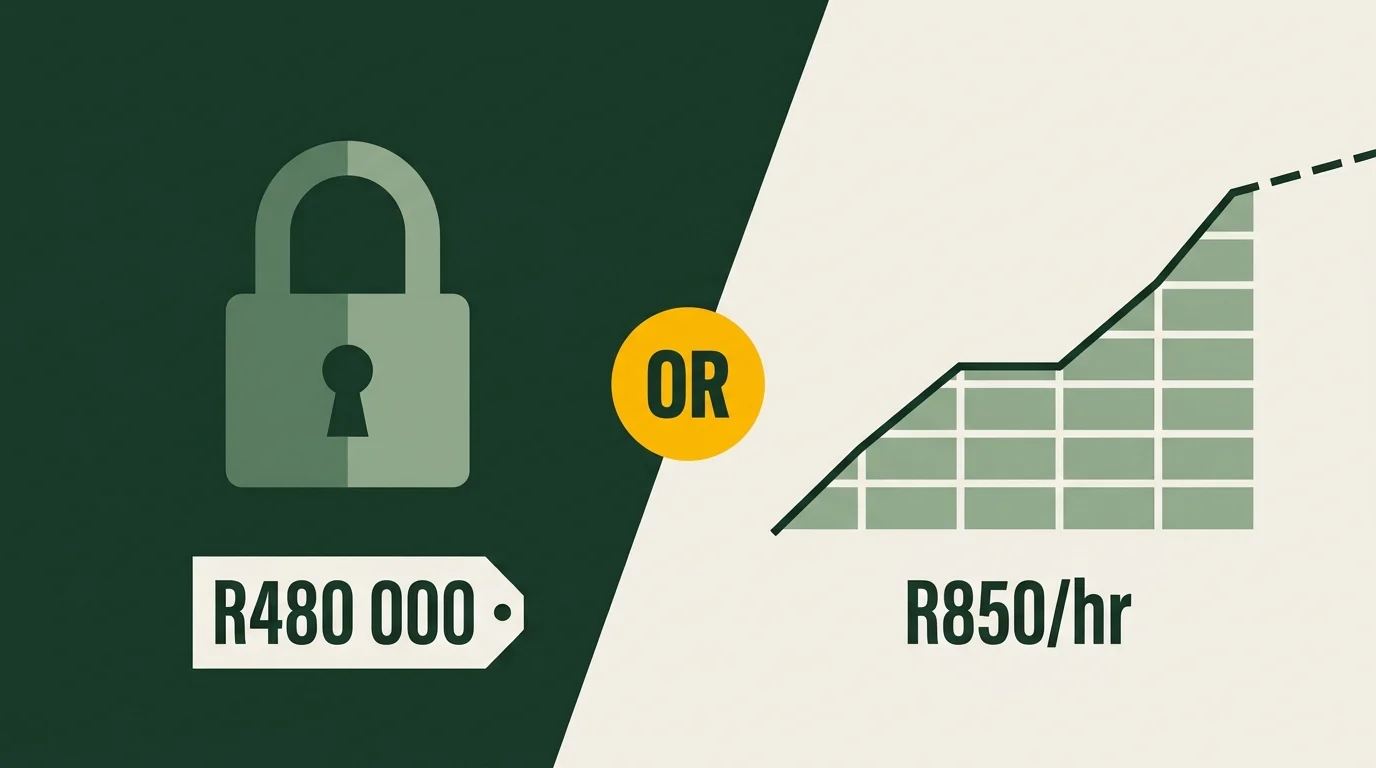
Two quotes land in your inbox for the same project. One says R480,000, all in. The other says R850 per hour, estimated 520 hours. They look like different prices. They are actually different risk structures — and the one you choose will shape how the project behaves long after the invoice is settled.
Here's how each model works, what it costs in South Africa, and how to pick without gambling your budget.
What is a fixed price software contract?
A fixed price contract sets one agreed figure for one agreed scope. The vendor commits to a defined list of features, a defined timeline, and a defined price. If the work takes longer than estimated, the vendor absorbs the cost.
That protection is real, and it is not free. Because the vendor carries the overrun risk, they price for it — industry estimates commonly put the contingency buffer built into fixed quotes at roughly 15% to 30% of the total. You are, in effect, paying an insurance premium against the unknown.
Fixed price also changes behaviour on both sides of the table. Every change request becomes a negotiation, because every change threatens the vendor's margin. That is fine when the scope genuinely is fixed. It becomes friction when it isn't.
Fixed price works when:
- The scope is documented to the screen and rule level
- The project is short (typically under three months)
- You need a hard budget ceiling for board or funder approval
- Little to nothing about the requirements is expected to change
What is a time and materials contract?
A time and materials (T&M) contract bills for hours actually worked at an agreed rate. There is an estimate, but no fixed total. You steer the backlog sprint by sprint and can reprioritise as you learn.
The trade-off is symmetrical. You gain flexibility and you gain visibility — good T&M engagements come with time logs, sprint demos and a burn-rate you can watch weekly. What you give up is a guaranteed ceiling. Without discipline, "flexible" quietly becomes "open-ended."
Time and materials works when:
- The scope will evolve as real users touch the product
- You're building an MVP or a first version
- The project runs longer than three months
- You want to ship in priority order and stop when the value curve flattens
Fixed price vs time and materials: the honest comparison
| Fixed price | Time & materials | |
|---|---|---|
| Total cost | Known upfront | Estimated, tracked weekly |
| Who carries overrun risk | Vendor | Client |
| Typical premium | ~15–30% contingency built in | None, but no ceiling |
| Scope changes | Formal change request, re-quote | Reprioritise the backlog |
| Client time required | Low during build | Moderate — weekly decisions |
| Time to start | Slower (full spec first) | Faster (start with sprint one) |
| Best project length | Under 3 months | 3 months and up |
| Biggest risk | Spec was wrong, and now it's locked in | Budget drifts without governance |
The uncomfortable truth behind both columns: the Standish Group's long-running CHAOS research has found that only around a third of software projects finish on time, on budget and in scope — a figure that has barely moved across three decades of waterfall, agile and hybrid delivery. Unclear requirements consistently rank as the single most-cited cause. No contract model fixes that. Only a proper discovery phase does.
How much do software developers charge per hour in South Africa?
Rates vary widely by seniority, delivery model and city. Published 2026 market guides put South African agency rates in a broad band, with Cape Town at the premium end. Treat these as indicative — the only number that matters is the one attached to your actual scope.
| Engagement type | Indicative rate (ZAR/hour, ex VAT) |
|---|---|
| Freelance developer (mid-level) | R350 – R700 |
| Senior freelance specialist (React, Node, Python) | R700 – R1,200 |
| Local agency / studio | R450 – R1,200 |
| Cape Town agency (premium tier) | R800 – R1,200 |
Two notes South African buyers should hold onto:
VAT. Software development services are standard-rated. SARS confirms the VAT rate remains 15% in 2026, with compulsory registration above R2.3 million in taxable turnover. If a quote doesn't say "excl. VAT" or "incl. VAT", ask before you compare it to anything.
Rate is not cost. A R1,200/hour senior who scopes correctly and ships in 200 hours is cheaper than a R500/hour team that takes 700 hours and rebuilds twice. Compare total delivered cost against outcome, not hourly rates against each other. We break the full picture down in our guide to what custom software actually costs in South Africa.
Comparing quotes right now? Bring them to a no-obligation discovery call. We'll walk through the scope, the assumptions and the risk structure — whether or not you build with us. Book a call →
What about the dedicated team or retainer model?
There's a third structure that rarely makes the headline comparison but suits a lot of growing businesses: a dedicated team on a monthly retainer.
You pay a predictable monthly fee for a defined team capacity. You own the backlog; the vendor owns staffing, continuity and retention. Because there is no per-project scope contingency to price in, vendors commonly report retainers landing cheaper than equivalent fixed-price work over engagements of six months or more.
The retainer model earns its keep when software is not a once-off project but an ongoing capability — a platform that ships improvements every month, or a product with a real roadmap. It's the wrong shape for a single, bounded deliverable like a marketing site.
| Model | Pay for | Scope | Best for |
|---|---|---|---|
| Fixed price | An outcome | Locked | Short, fully specified builds |
| Time & materials | Hours worked | Fluid | Discovery-heavy or evolving products |
| Dedicated team | Team capacity per month | Continuous | Long-running platforms and roadmaps |
The hybrid most projects actually need
In practice, the best structure for a South African SME is rarely one pure model. It's a sequence.
1. Paid discovery (fixed price, small). Two to three weeks. Requirements, user flows, data model, integration list, technical approach. It costs a fraction of the build and it converts unknowns into knowns. Skipping it is the single most expensive decision on most projects.
2. Fixed-price delivery phases. Discovery output is precise enough to quote against with confidence — so phase one gets a real fixed price, not a hedged guess. Each phase is small enough to specify honestly and ships something usable.
3. Capped time and materials for the tail. Refinements, feedback-driven changes and polish run on T&M with an agreed monthly ceiling. Flexibility where you need it; a ceiling where you need that.
This is how we structure work across custom software, web design and development and mobile apps at Syniq. Our Cape Town team runs the build in-house with weekly demos — no offshore handoffs and no month-long silences.
If your requirement is standard business operations rather than something bespoke, the calculation changes entirely. Syniq Business OS is a subscription — sales, operations, finance and support in one platform, at published pricing, with no build risk at all. Buy where the problem is solved; build where you're actually different.
What to check before you sign
Regardless of model, a South African software contract should be explicit about these seven things.
- IP ownership. You should own the source code and assets on final payment. Get it in writing.
- Acceptance criteria. How is "done" decided? Vague acceptance clauses are where fixed-price projects go to die.
- Change control. A named process, a turnaround time and a rate for changes — not an argument waiting to happen.
- Payment schedule. Tied to delivered milestones, not calendar dates.
- VAT treatment. Stated clearly, on every line.
- Data protection. Who processes personal data, where it's hosted, and what happens at termination. POPIA makes you accountable for your operator's handling of that data, not just your own.
- Exit terms. What you receive if the relationship ends mid-project: code, credentials, documentation, environments.
A vendor who answers all seven quickly and in plain language is telling you something useful about how the project will run.
The decision, in one paragraph
If your scope is genuinely locked and the project is short, take fixed price and enjoy the certainty. If you're building something new and the requirements will move, take time and materials with a monthly cap and weekly demos. If software is becoming a permanent function of your business, take a retainer. And in almost every case, buy a discovery phase first — it's the cheapest risk you'll ever remove. A clear project brief gets you most of the way there before you even speak to a vendor.
Planning a software project
Syniq quotes custom software after a free discovery call: one fixed price for the agreed scope, with no hourly billing, and the source code and design are yours on final payment. See how a custom software project works.
- What custom software costs in South Africa
- How to write a software project brief
- How long custom software takes to build
- Who owns the code you paid for
Frequently asked questions
Which is cheaper, fixed price or time and materials? Time and materials is usually cheaper in total, because fixed-price quotes include a contingency buffer commonly estimated at 15–30% to cover the vendor's overrun risk. Fixed price is more predictable, which is a different kind of value. If certainty matters more than the last rand, the premium is often worth paying.
Can a software project be fixed price without a full specification? Not honestly. A fixed price without a specification is either a guess with a large hidden buffer, or a quote that will be revised the moment reality arrives. Run a short paid discovery phase first, then fix the price against the output.
How much do software developers charge per hour in South Africa? Published 2026 market guides put agency rates broadly between R450 and R1,200 per hour excluding VAT, with Cape Town agencies at the upper end and senior freelance specialists in a similar band. Rates vary with seniority and stack — book a scoping call for a fixed quote against your actual scope.
Is VAT charged on software development in South Africa? Yes. Software development services are standard-rated at 15% when supplied by a VAT-registered vendor. Always confirm whether a quote is inclusive or exclusive before comparing it to another.
What is a capped time and materials contract? It bills hourly like standard T&M but sets an agreed ceiling — usually monthly. You keep the flexibility to reprioritise, and you keep a hard budget limit. It's the most common compromise structure for evolving projects.
Who owns the code in a custom software project? Whoever the contract says. Reputable South African developers transfer full IP to the client on final payment. If a proposal is silent on ownership, treat that as a red flag and resolve it before signing.
Get a straight answer on your project
You don't need to decide on a contract model in the abstract. Bring us the problem, and we'll tell you which structure fits — fixed price, phased, retainer, or a subscription that means you don't build at all.
Book a no-obligation discovery call →
Syniq (Pty) Ltd — Cape Town. Design · Build · Transform.