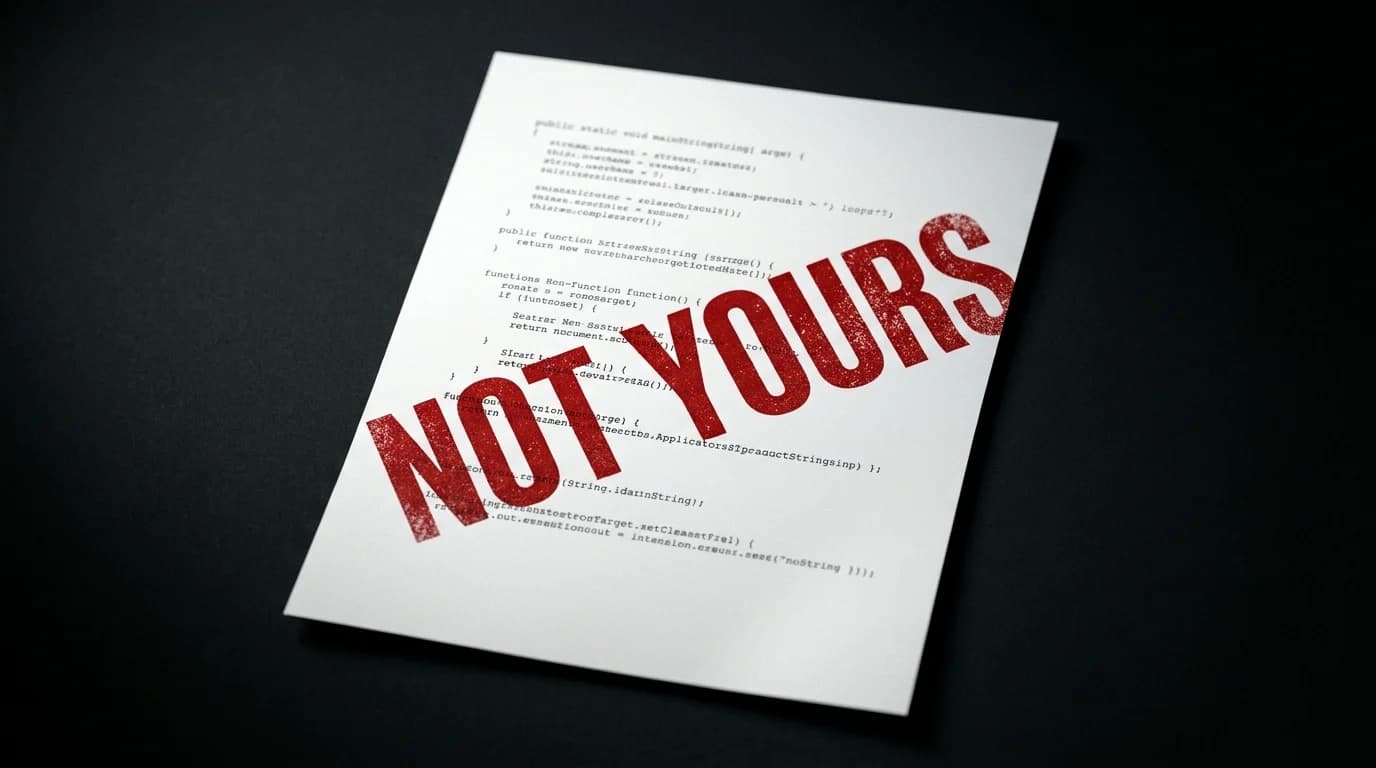
In South Africa, paying for software does not automatically make you its owner. Under the Copyright Act 98 of 1978, copyright in a computer program vests in the person who exercised control over its making — and it can only be transferred by a written assignment signed by that owner. Without that clause, your developer may keep the code.
That surprises most business owners. You briefed the work, approved the designs, paid every invoice on time. But copyright in South Africa follows authorship, not the invoice — and for computer programs the law defines "author" in a way that catches well-meaning businesses off guard, usually two or three years later when they want to change developers, raise funding, or sell the company.
Here's what the law says, what a proper ownership clause looks like, and how to audit software you've already paid for. General information, not legal advice.
Who owns custom software in South Africa — the developer or the client?
Start with the default, because that's what applies when your contract is silent. The Copyright Act 98 of 1978 treats a computer program as its own category of protected work. Protection is automatic — copyright exists the moment code is written, and there is no software copyright register in South Africa. Section 21(1)(a) says the default owner is the author. Two exceptions matter:
- Section 21(1)(d) — employees. Where a work is made in the course of employment under a contract of service, the employer owns the copyright. A developer on your payroll, writing code inside their job description, produces code your company owns.
- Section 21(1)(c) — commissioned works. Where someone commissions and pays for certain works, the commissioning party owns the copyright. The catch: it applies to a closed list — photographs, portraits, gravures, films and sound recordings. Computer programs are not on that list.
So the "I commissioned it, therefore I own it" instinct is right for a corporate photoshoot and wrong for a custom platform.
What is the "control" test, and does it protect you?
For most works, the author is whoever created them. For a computer program, the Act defines the author as "the person who exercised control over the making of the computer program."
That opens a door for clients: you don't have to write code to be the author, you have to have directed the work. Our courts have drawn the line twice:
- In Haupt t/a Softcopy v Brewers Marketing Intelligence, the Supreme Court of Appeal held that "control" is broader than employment-style supervision and can apply even to an independent contractor. Haupt specified the result, issued and reviewed instructions, approved the work, and could start or stop development at will. He was the author, despite not being the programmer.
- In Bergh and Others v The Agricultural Research Council, the same court found the opposite on weaker facts: supplying functional requirements and periodically reviewing progress was not enough to establish control. The developer was the author.
The practical lesson is uncomfortable: ownership could turn on how detailed your emails were and whether anyone kept the minutes. That's a poor foundation for a business asset — and there's a better one that takes a single clause.
Why a written assignment is the only clause that settles it
Copyright can be assigned — but only in writing, signed by the assignor. A verbal agreement doesn't do it. A paid invoice doesn't do it. An unsigned proposal deck doesn't do it.
Without one, the developer holds the copyright and you hold an implied, non-exclusive licence to use the software as intended. You can run it and back it up. What you generally cannot do is treat it as an asset you control: relicense it, sell it with the business, or hand the repository to a new team.
Two related points. Moral rights under section 20 — the author's right to be identified and to object to derogatory treatment — stay with the author; an assignment moves the economic rights, not these. And copyright in a computer program runs for 50 years, so this is not a problem you can wait out.
Reviewing a contract right now? Our team will walk through the IP, delivery and exit clauses with you before you sign — no obligation, no sales pitch. Book a discovery call.
Own, licence, or subscribe — which model do you actually need?
Full ownership isn't automatically the right answer — it's the right answer when the software is the differentiator. Plenty of businesses are better served by a licence or a subscription, and pay considerably less.
| Model | What you get | What you don't get | Best when |
|---|---|---|---|
| Full assignment of copyright | Freedom to modify, relicense, resell, or change development teams. | The developer's pre-existing libraries and open-source components (you licence those). | The software is a core competitive asset or something you'll commercialise. |
| Perpetual licence + source code | Indefinite right to use and, if negotiated, modify. Source code in your repository. | The right to resell or relicense the code as your own product. | You need continuity and independence, but the code isn't a saleable asset. |
| SaaS subscription | A maintained, continuously improved product for a predictable monthly fee. Your data stays yours. | Any ownership of the platform code. | A well-built platform already solves the problem. |
| Hybrid: licensed platform + owned extensions | A subscription core, plus assignment of the custom modules and integrations built for you. | Ownership of the underlying platform. | You need 80% standard operations and 20% genuinely bespoke workflow. |
That last row is how a lot of growing South African businesses should be buying software. You don't need to own an invoicing engine or a CRM pipeline — those are solved problems, and Business OS exists so you don't have to fund them from scratch. What you may need to own is the workflow that makes your business different. See Business OS pricing, or Custom Software if bespoke is the right call. We have set out the money side of that decision separately, in monthly SaaS versus a custom build.
What should an IP clause in a software development contract cover?
Run this against any proposal or MSA on your desk.
- A written assignment of copyright, signed by the developer entity, covering all bespoke code, designs, database schemas and documentation created for you.
- A clear trigger for when ownership transfers — on creation, on milestone payment, or on final payment. All are workable; it just has to be stated.
- A background IP carve-out. Developers reuse their own frameworks and libraries — that's what makes them affordable. You need a perpetual, irrevocable, royalty-free licence to use that background IP inside your product, not ownership of it.
- A third-party and open-source component register, with the licence type for each. Some open-source licences carry conditions that matter if you ever distribute or resell the software.
- A delivery definition. "Source code" isn't enough: specify the Git repository and history, CI/CD configuration, infrastructure-as-code, environment documentation, design files, and accounts held on your behalf.
- Warranties and indemnity that the code doesn't infringe third-party rights, with a sensible liability cap.
- Data ownership stated separately from software ownership — conflating the two is a common and costly mistake.
- Transition assistance on exit — defined handover hours at a stated rate, so leaving is a process rather than a fight.
Most of this is far easier to negotiate before the work is scoped than after. If you are still at the briefing stage, our guide to writing a software project brief covers what to put in front of a developer in the first place.
What happens to your code if your developer disappears?
Ownership on paper is worth little if you can't physically reach the code.
Source code escrow is the formal answer: a tripartite agreement where the developer deposits source code and build materials with an independent agent, released on defined triggers — insolvency or business rescue, product abandonment, or material unremedied breach of support obligations. It's well established in South Africa and standard for mission-critical systems.
For most SMEs there's a free version: own the accounts. Your company should own the Git organisation, cloud hosting, domain registrar, database and app store accounts, with your developer added as a collaborator — not the other way around. Escrow protects you from vendor failure; account ownership protects you from a vendor falling out with you, which is far more common.
If you take one action from this article, take that one.
Does offshore development complicate ownership?
It adds a layer. Assigning South African IP to a non-resident falls under exchange control, which treats intellectual property as "capital" and its transfer offshore as an export of capital. The framework has been progressively relaxed — residents may assign IP to unrelated non-resident parties at arm's length and fair market value — but Authorised Dealers still require the agreement plus an auditor's letter or valuation certificate, and non-standard structures attract scrutiny.
Cross-border builds are manageable; the paperwork just has to be right, alongside time zones, handover risk, and which country's courts you'd be in if the assignment were disputed.
Syniq builds in-house in Cape Town with no offshore handoffs — partly a quality decision, partly this. One entity, one jurisdiction, a signed assignment, code in a repository you own. Whether it's a platform, a website or a mobile app, the ownership chain should be one link long.
Do you own your data if you don't own the software?
Yes, and the distinction matters. You can subscribe to a platform you'll never own and still be the unambiguous owner of every record inside it. Under POPIA, if you determine the purpose and means of processing personal information you are the responsible party; a vendor processing it on your instruction is an operator, and section 21 requires a written contract obliging that operator to maintain appropriate security safeguards.
What to insist on, whichever model you choose:
- An explicit statement that all customer, transaction and operational data remains yours.
- A written operator agreement covering security measures and breach notification.
- Export on demand, in a usable format — not a PDF dump. If you can't get your data out, you don't control it.
- Defined deletion and return obligations when the relationship ends.
Our approach is set out in Syniq's POPIA commitments.
A five-minute audit of software you've already paid for
- Do you have a signed written agreement assigning copyright to your company? A quote and an invoice are not an assignment.
- Is your company the registered owner of the code repository, hosting, domain and app store accounts?
- Do you have a current, restorable copy of the source code and database — not just a running system?
- Do you know which third-party services the system depends on, and whose card is on file for each?
- If your developer stopped answering the phone tomorrow, could another team take over — and how long would it take?
More than one "no" isn't a crisis, but it's a gap worth closing while the relationship is still good. Ownership problems are cheap to fix in advance and expensive to fix in a dispute.
Planning a software project
Syniq quotes custom software after a free discovery call: one fixed price for the agreed scope, with no hourly billing, and the source code and design are yours on final payment. See how a custom software project works.
- Fixed price or time and materials
- How to choose a software development company
- What maintenance costs after launch
- What custom software costs in South Africa
Frequently asked questions
Does paying for software mean I own the copyright in South Africa? No. Computer programs fall outside the Copyright Act's commissioned-works exception, so ownership follows authorship unless there is a written assignment signed by the copyright owner. Without one you typically hold an implied licence to use the software, not ownership of it.
Who is the "author" of a computer program under South African law? The Act defines the author as the person who exercised control over the making of the program. Courts have held this is broader than employment supervision: a client who directs the work, issues and reviews instructions, and can start or stop development may be the author. It is fact-dependent, which is why a written assignment is safer.
Do I own software written by my own employees? Generally yes. Where a work is made in the course of employment under a contract of service, the employer owns the copyright. The qualifier matters: code written outside an employee's role and scope may not be covered, so employment contracts should address IP explicitly.
Can I register copyright in my software in South Africa? No. There is no software copyright register in South Africa; protection is automatic from the moment code is created. Copyright in a computer program lasts 50 years from the end of the year it was first made available to the public, or the year it was made, whichever is later.
What is source code escrow and does my business need one? Escrow is a tripartite agreement where a developer deposits source code with an independent agent, released to you on insolvency, product abandonment, or material breach of support obligations. Worth the cost for mission-critical systems; for most SMEs, owning the repository, hosting and domain accounts delivers most of the protection for free.
If I subscribe to a platform instead of building, who owns my data? You do — software ownership and data ownership are separate. Under POPIA you remain the responsible party for personal information you control, and your vendor acts as an operator under a written agreement. Insist on a data-ownership clause, an operator agreement, and on-demand export.
Own the outcome, not just the invoice
The businesses that get burned by this rarely chose badly. They just never asked the question, because "we paid for it" felt like a complete answer. It isn't — not under South African law, and not when a funder, an acquirer or a new development team asks for proof.
Get the assignment in writing. Own the accounts. Keep software ownership and data ownership as two separate questions. Then decide honestly which parts of your stack are worth owning at all — because for much of what a growing business runs on, subscribing to something already built is the smarter capital decision.
Want a second pair of eyes on a contract, an existing build, or the build-versus-subscribe question itself? Book a no-obligation discovery call. We'll tell you what we'd do, whether or not it involves us.
Written by Mikhail for Syniq (Pty) Ltd. Syniq is a Cape Town software company building Business OS and custom software for growing South African businesses. This article is general information about South African law and is not legal advice — for advice on a specific agreement, consult a qualified intellectual property attorney.