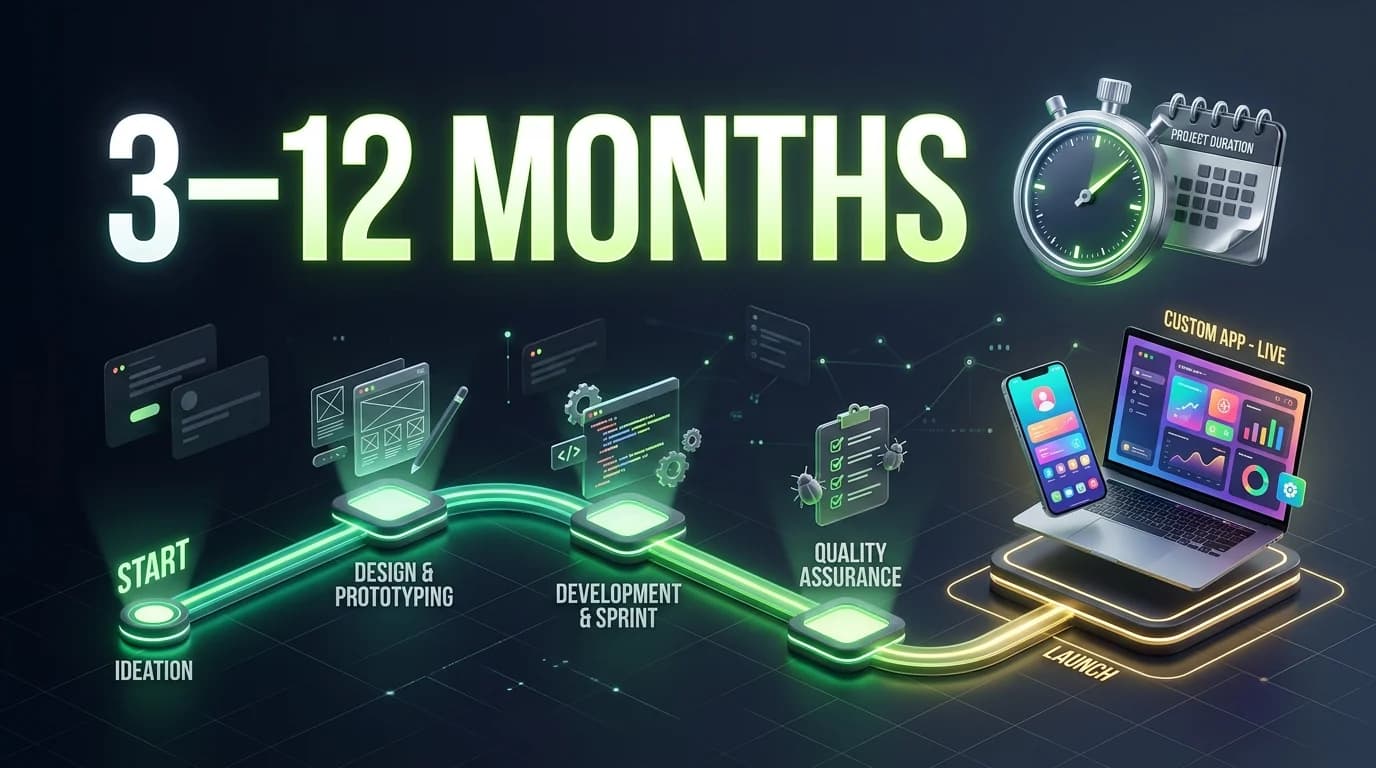
Most custom software takes 3 to 12 months to build. A focused MVP ships in 2-4 months, a mid-sized platform in 6-9 months, and complex, integration-heavy systems in 12-24 months. Your real timeline is set by four things: how wide the scope is, how many systems it connects to, the size of the team, and how quickly you make decisions.
That is the honest headline answer. The longer answer is more useful, because "custom software" covers everything from a single-workflow internal tool to a multi-tenant platform that runs an entire company. Below is the phase-by-phase breakdown, the factors that stretch or compress the schedule, and how to get working software into users' hands faster without gambling on quality.
What's the realistic timeline for custom software?
Think of a software build like building a house. A garden studio and a double-storey family home follow the same stages, but nobody expects them to take the same time. The most reliable way to estimate is to place your project into a size band first, then refine from there.
| Project type | Example | Typical timeline |
|---|---|---|
| MVP / proof of concept | Booking tool, internal dashboard, single-workflow app | 2-4 months |
| Mid-sized platform | CRM, marketplace, multi-role web app, customer portal | 6-9 months |
| Complex / enterprise system | Multi-tenant SaaS, ERP, heavy third-party integrations | 12-24 months |
These are calendar ranges from kickoff to a live, production-ready release, assuming a dedicated team and reasonably clear requirements. A simple product with three to five core features on a single platform sits comfortably at the fast end; the moment you add multiple user roles, payment flows, and integrations, you move up a band.
The bands are a starting point, not a quote. Two "CRMs" can differ by six months depending on how much they need to do. For a firm number tied to your actual feature list, book a scoping call and we will map it out.
What are the phases of a custom software build?
Every serious build moves through five phases. In a modern custom software development process these overlap rather than run in a strict line - testing happens alongside development, not after it - but each still owns a chunk of the calendar.
| Phase | What happens | Typical duration |
|---|---|---|
| Discovery & scoping | Requirements, research, technical roadmap, estimates | 2-4 weeks |
| UX / UI design | Wireframes, clickable prototype, design system | 3-6 weeks |
| Development | Front end, back end, database, integrations | 2-9 months |
| Testing & QA | Bug fixing, security, performance and load testing | 3-6 weeks (runs alongside development) |
| Deployment & launch | Release, cloud configuration, data migration, handover | 2-4 weeks |
Discovery and scoping is the phase people are most tempted to skip, and the one that quietly protects the whole timeline. Two to four weeks spent turning a vague idea into a defined feature list, a roadmap, and a realistic estimate saves months of rebuilding later. Skip it and you pay the time back with interest.
Design turns the plan into something you can see and click before a line of production code exists. Getting the flow right on a prototype is far cheaper than discovering it is wrong in a finished build.
Development is the long pole - anywhere from two months for a lean MVP to nine months or more for a complex platform. This is where the front end, back end, database, and integrations get built and wired together.
Testing is not a phase you bolt on at the end. In an agile build it runs continuously; quality assurance typically absorbs close to a third of total engineering effort, catching bugs while they are cheap to fix rather than after launch.
Deployment is the shortest phase but rarely instant. Cloud configuration, migrating your existing data, and handing over to your team properly takes a couple of weeks for most projects.
Why do custom software timelines vary so much?
If two projects that sound identical can finish months apart, it is usually down to a handful of variables. These are the levers that move your date:
- Scope and complexity. The number of features, and how intricate each one is, drives everything else. Ten simple screens are faster than three that each contain complex logic, permissions, and edge cases.
- Integrations. Every external system you connect to - a payment gateway, an accounting package, a courier API, a SARS-compliant invoicing flow - adds build and testing time. Integrations are where "quick" projects quietly become medium ones.
- Clarity of requirements. Unclear or shifting requirements are the single biggest time-killer in software. Mid-build changes, known as scope creep, force rework and reset estimates. A tight brief up front is the cheapest speed-up available.
- Team size and structure. More developers is not linearly faster. A medium build might take a small team of three to five people six to nine months; a larger team can compress that, but past a point, coordination overhead adds time rather than removing it. Communication is the hidden cost of a big team.
- Decision speed on your side. The build waits when approvals wait. Fast, empowered feedback from the client is one of the most underrated accelerators of any project.
Notice that only two of these five are about the code. The rest are about clarity, communication, and decisions - which is why the way a team runs a project matters as much as how fast it types.
Need it running sooner than a full build allows? Syniq's Business OS gives growing South African businesses sales, operations, marketing, finance, and support in one ready platform, with a 14-day free trial to try it on your own work. Talk to us about the fastest route to your outcome.
How long does it take to build an MVP?
An MVP - a minimum viable product - is the fastest honest way to get real software into users' hands. Instead of building every feature you can imagine, you build the smallest version that delivers genuine value, launch it, and learn from actual usage.
A focused MVP with a tight, well-defined scope typically ships in 2-4 months, and a lean one can reach real users in as little as 8-10 weeks when requirements are clear from day one. A fuller version-one release, hardened and feature-complete, usually follows at the 6-9 month mark.
The MVP route is not about cutting corners; it is about cutting the queue. You get to market sooner, spend less before you have proof, and let real feedback - not guesswork - decide what gets built next. For most businesses, this is the smart place to start. We cover the thinking in depth in what is an MVP and why you should start there.
Does a mobile app take longer to build than a web app?
Often, yes - but it depends on how you build it. A web application runs in the browser and ships to everyone at once, so there is one codebase to build, test, and update. A mobile app adds platform-specific work, device testing across many screen sizes, and app-store review before anyone can download it.
The lever here is your technology choice. A cross-platform framework such as React Native builds a single codebase that runs on both iOS and Android, which typically lands faster than writing two fully native apps. Native development gives the deepest performance and hardware access but roughly doubles the platform-specific effort. If speed to market is the priority, cross-platform usually wins; if you need cutting-edge device performance, native may earn its extra weeks.
What's the fastest way to build custom software without cutting corners?
Speed in software rarely comes from working harder. It comes from removing the things that cause rework and waiting. The projects that finish on time tend to share the same habits:
Start with a tight, ruthlessly prioritised scope - a smaller first release moves through design, build, and testing faster and surfaces problems earlier. Run short feedback loops: at Syniq we demo working software every week, so course corrections happen in days, not at a painful reveal months in. Keep a dedicated, in-house team on the project - context-switching between projects and offshore handoffs both leak time. And make decisions quickly, because an empowered client who unblocks the team same-day is worth more to the timeline than another developer.
Our Cape Town team builds this way by default: no offshore handoffs and a demo every week. The result is a schedule you can plan around and software that holds up once it is live.
Build it or buy it?
The fastest software is the software you do not have to build. If your need is a common one - CRM, invoicing, operations, support - a ready-made platform can be live in days. Custom software earns its longer timeline when your process is your advantage and no off-the-shelf tool fits it. Most growing businesses end up with a mix: buy the commodity workflows, build the parts that make you different. If you are weighing this up, our build vs buy decision framework walks through the trade-offs.
Get a realistic timeline for your project
The ranges here will get you in the right ballpark, but your project deserves a real number. In a short discovery call we will pressure-test your scope, flag the integrations that move the date, and give you a phased timeline you can actually plan around - with the fastest sensible path to something live.
Book a no-obligation discovery call and let's map your build, week by week.
Planning a software project
Syniq quotes custom software after a free discovery call: one fixed price for the agreed scope, with no hourly billing, and the source code and design are yours on final payment. See how a custom software project works.
- What an MVP is, and why to start there
- What custom software costs in South Africa
- How to write a software project brief
- Fixed price or time and materials
Frequently asked questions
How long does it take to build custom software? Most custom software takes 3 to 12 months. A focused MVP ships in 2-4 months, a mid-sized platform in 6-9 months, and complex enterprise systems in 12-24 months. The exact timeline depends on scope, integrations, team size, and how quickly decisions are made.
How long does it take to build an MVP? A minimum viable product with a tight scope typically takes 2-4 months, and a lean MVP can reach real users in 8-10 weeks when requirements are clear. A hardened version-one release usually follows around the 6-9 month mark.
Does a mobile app take longer to build than a web app? Usually. A web app is one codebase that ships to everyone at once, while a mobile app adds platform-specific work, wider device testing, and app-store review. Choosing a cross-platform framework like React Native, rather than two fully native apps, can significantly shorten the mobile timeline.
Can you speed up a build by adding more developers? Only up to a point. A larger team can compress a schedule, but past a certain size, coordination and communication overhead add time rather than removing it. Clear scope, short feedback loops, and fast client decisions speed a project up more reliably than extra headcount.
How long does custom software take to build in South Africa? The same phase timelines apply. Local agile teams can typically stand up a dedicated squad within a few weeks of a signed contract and deliver an MVP in 2-4 months. Working with an in-house Cape Town team like Syniq's removes offshore handoffs and time-zone lag that stretch schedules.
What slows a software project down the most? Unclear or changing requirements. Scope creep - features added or changed mid-build - forces rework and resets estimates. A detailed brief up front and disciplined change management are the cheapest, most effective ways to protect your timeline.