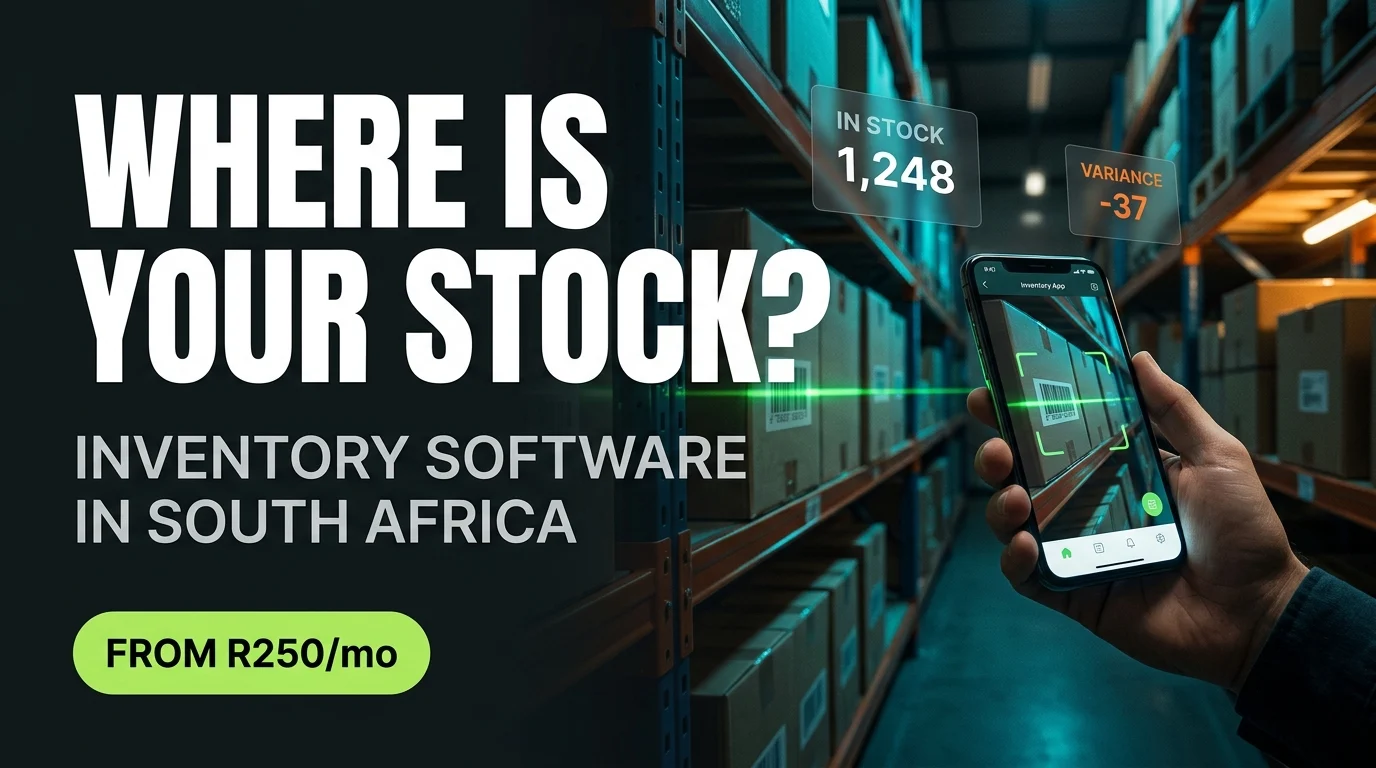
Inventory management software tracks what stock you hold, where it sits, what it cost and when to reorder — in real time, across every location and sales channel. In South Africa, expect roughly R250–R900 per month for small-business tools, R1,000–R5,000+ per month for multi-warehouse systems, and a custom build where your stock logic is genuinely unusual.
Most South African businesses do not lose money on stock because they chose the wrong software. They lose it because there is no system at all — just a spreadsheet, a WhatsApp group and one person who "knows where everything is." That works until it doesn't: until a customer is promised stock that shipped last week, until a quarterly stock take turns up a variance nobody can explain, or until that one person resigns.
This guide covers what these systems do, what they cost locally, and how to tell which of the four options actually fits your business.
What does inventory management software actually do?
Strip away the feature lists and a stock control system does five things:
- Holds a single source of truth for stock levels. One number per SKU per location, updated the moment something is sold, received, moved or written off.
- Tracks stock movement, not just stock counts. Every unit has a history — received on this GRN, moved to that branch, sold on that invoice. Variance stops being a mystery and becomes a traceable event.
- Values your stock correctly. Cost price, landed cost, FIFO or weighted average — the number that feeds your balance sheet and your gross margin.
- Triggers reordering before you run out. Reorder points, lead times and supplier records so purchasing is a decision, not a scramble.
- Reconciles counts. Structured stock takes and cycle counts that produce a variance report instead of an argument.
A useful way to think about it: your accounting system tells you what stock is worth. Your inventory system tells you where it is. You need both to be true at the same time.
Holding stock is not free. Inventory carrying cost — capital tied up, storage, insurance, handling, shrinkage and obsolescence — is widely benchmarked at roughly 15–25% of inventory value per year, and higher for bulky, perishable or slow-moving goods. On R2 million of stock, that is R300,000–R500,000 a year of cost attached to the decision of how much to hold. Software does not remove that cost. It gives you the visibility to stop overstocking into it.
Shrinkage is the other side of the same coin. Research on retail SMMEs in the City of Tshwane found stock spoilage and internal theft to be the strongest predictors of lost profitability and sales volume, with 57.7% of respondents reporting some level of shoplifting impact. You cannot manage what you cannot measure — and a spreadsheet updated weekly measures nothing in a way that would survive scrutiny.
How much does inventory management software cost in South Africa?
Local pricing sits in four fairly clear bands. Treat these as indicative ranges — actual cost depends on user count, locations, SKU volume and integrations.
| Tier | What you get | Indicative monthly cost (ZAR) | Best suited to |
|---|---|---|---|
| Accounting add-on | Basic stock items, quantity tracking, cost price, stock on invoices | ~R250–R450/mo (e.g. Zoho Books Essentials ~R408/mo; Sage Accounting from ~R350/mo) | Service businesses with light stock; under ~200 SKUs, one location |
| Dedicated inventory tool | Multi-location, reorder points, barcode scanning, purchase orders, stock takes | ~R900–R2,500/mo | Retail, e-commerce and wholesale with real stock movement |
| All-in-one operations platform | Inventory inside one system with sales, invoicing, support and reporting | Varies by module and seat count | Businesses tired of paying for and reconciling five separate tools |
| Custom-built | Stock logic modelled to your actual operation, integrated end to end | Once-off build + hosting and support | Non-standard stock: batches, serials, assemblies, consignment, field stock |
Two costs almost never appear on the pricing page, and both are real:
- Implementation and data migration. Opening balances, SKU cleanup, supplier records, barcode setup. Budget for it explicitly.
- The integration tax. Every system that does not talk to the next one costs somebody hours every week. We wrote about this in the hidden cost of disconnected business tools — it is usually the largest number in the whole exercise, and the least visible.
For a fixed quote against your actual SKU count and locations, book a no-obligation discovery call. We scope before we price.
Do I need dedicated inventory software, or is my accounting package enough?
Your accounting package is probably enough if all of the following are true:
- One location, one sales channel
- Fewer than a couple hundred SKUs
- No batch, serial, expiry or assembly tracking
- Stock moves in and out in simple, whole units
- A monthly stock take is sufficient
The moment two or more of these break, the accounting module starts costing you more in workarounds than a proper system would cost in licence fees. The classic tell is the shadow spreadsheet: the "real" stock sheet somebody maintains next to the accounting system because the accounting system cannot represent how the business actually works.
If your accounting side is also creaking — VAT handling, SARS-compliant invoicing, reconciliations — solve both at once rather than sequentially. Syniq's Finance and Accounting module handles tax-compliant invoicing inside the same platform that holds your operations data, and our Sage alternative comparison walks through what changes when your accounting and operations stop living in separate systems.
What features should a South African business look for?
Not every feature on the demo matters. These do.
Multi-location and in-transit stock. If you have a shop and a storeroom, that is two locations. Stock moving between them must be visible while it is moving, not just at each end.
Barcode scanning that works on the floor. Scanning on a phone camera is fine for most SMEs and removes the single largest source of counting error: typing.
Landed cost. Imported goods carry freight, duties, clearing and forex. If your system records only the invoice price, every imported SKU shows a fatter margin than it earns. This is the most common margin distortion we see in South African stockholding businesses.
Cycle counting, not just annual stock takes. Counting a slice of your SKUs continuously catches variance while the cause is still traceable. An annual count catches it a year late.
VAT-correct documents. Purchase orders, GRNs, credit notes and invoices that stand up to a SARS review without manual patching.
Offline tolerance. Warehouses have thick walls and unreliable connectivity. A system that stalls when the signal drops will be abandoned by the people who have to use it.
An open API. Your stock system will need to talk to your online store, your accounting, your couriers. If it cannot, you have bought a new silo.
POPIA-appropriate handling. Supplier and customer records inside your inventory system are personal information under POPIA. Data residency, access control and audit logs are not optional extras — see our POPIA commitments.
Where does an all-in-one platform fit?
Most stock problems are not really stock problems. They are handover problems: sales promises what operations cannot deliver because sales cannot see the warehouse, and finance invoices from a third version of the truth.
That is the case for putting inventory inside your operating system rather than beside it. Syniq Business OS does not manage stock, but it runs Sales and CRM, Operations, Marketing, Finance, Support and an Executive dashboard on one data layer — so if you choose a separate stock tool, choose one that can connect to the system that holds your quotes and invoices.
You can see module and seat pricing on the Business OS pricing page.
When does a custom build make sense?
Buy the standard thing when your process is standard. That is not a compromise — it is the correct call for most businesses, and it is faster and cheaper.
Build when your stock logic is your business. Signals that you are in build territory:
- Stock that transforms — raw materials into assemblies, bulk into packed units, kits and BOMs
- Consignment, rental or returnable stock, where "sold" and "gone" are different events
- Serial, batch and expiry tracking with regulatory traceability requirements
- Stock held by technicians in vehicles, reconciled against jobs completed
- Pricing or allocation rules no off-the-shelf system can express without ten workarounds
- Counter sales that must update stock across a shop, a stockroom and an online store — a case for a custom POS
If you are counting workarounds rather than features, the off-the-shelf option has already failed. Our custom software team builds on Next.js, TypeScript, Supabase and PostgreSQL, in-house in Cape Town, with weekly demos — so you see the stock logic working against your real data long before go-live. For the decision framework itself, our build versus buy guide covers the full trade-off.
How long does implementation take?
Honest ranges, assuming your data is in reasonable shape:
| Scope | Typical timeline |
|---|---|
| Accounting stock module switched on | 1–2 weeks |
| Dedicated tool, single location | 2–6 weeks |
| Multi-location platform rollout | 6–12 weeks |
| Custom inventory build | 10–20+ weeks depending on scope |
The variable is almost never the software. It is your data. SKU codes that mean three different things, opening balances nobody trusts, suppliers recorded four ways. Clean that first and every timeline above compresses. Skip it and no system will save you — you will simply have digitised the confusion.
The bottom line
Inventory software earns its keep in three places: stock you no longer over-order, sales you no longer lose to phantom stock-outs, and hours your team no longer spends reconciling versions of the truth. Size the system to the complexity of your stock, not the size of your ambition — and make sure it talks to everything else you run.
Frequently asked questions
What is the difference between inventory management software and an ERP? Inventory software manages stock — levels, movement, valuation and reordering. An ERP manages the whole business, with inventory as one module alongside finance, sales, HR and procurement. Small stockholding businesses usually start with inventory software; complexity across multiple departments is what eventually justifies an ERP or an all-in-one platform.
How much does inventory management software cost in South Africa? Indicatively, R250–R450 per month for stock features inside an accounting package, R900–R2,500 per month for a dedicated multi-location tool, and a once-off build cost plus hosting for custom software. Implementation and data migration are additional and are frequently underestimated. Book a scoping call for a fixed quote.
Can I run stock control on a spreadsheet? For a single location with a handful of SKUs and one person updating it, yes. It breaks as soon as two people edit it, stock moves between locations, or you need to know what you had last Tuesday. Spreadsheets record numbers; they do not enforce them.
Does inventory management software work offline? The better systems do, at least partially — queuing scans and stock movements locally and syncing when connectivity returns. This matters more in South Africa than vendors from other markets assume. Test it in your actual warehouse before you sign.
Do I need barcode scanners, or will phones do? Phone cameras are accurate enough for most SME volumes and cost nothing extra. Dedicated scanners earn their price in high-volume picking environments where scan speed and battery life over a full shift genuinely matter.
Is inventory data covered by POPIA? The stock quantities are not, but the supplier and customer records attached to them are personal information under POPIA. Any system holding them needs proper access control, audit logging and clarity on where the data is stored.
Fix stock visibility properly
Count the workarounds, not the features. If your team maintains a shadow spreadsheet next to the system you already pay for, the system has already lost — and the cost is showing up as over-ordered stock, phantom stock-outs and month-end variance nobody can explain.
Book a no-obligation discovery call. We will map your current stock flow, tell you plainly whether you need a tool, a platform or a build, and give you a fixed quote for whichever it turns out to be.
Written by Mikhail for Syniq (Pty) Ltd. Syniq is a Cape Town software company building Business OS, websites and custom software for growing South African businesses. Pricing ranges are indicative for 2026 and move with scope, vendor and volume — confirm current rates directly with any provider before building a business case on them.