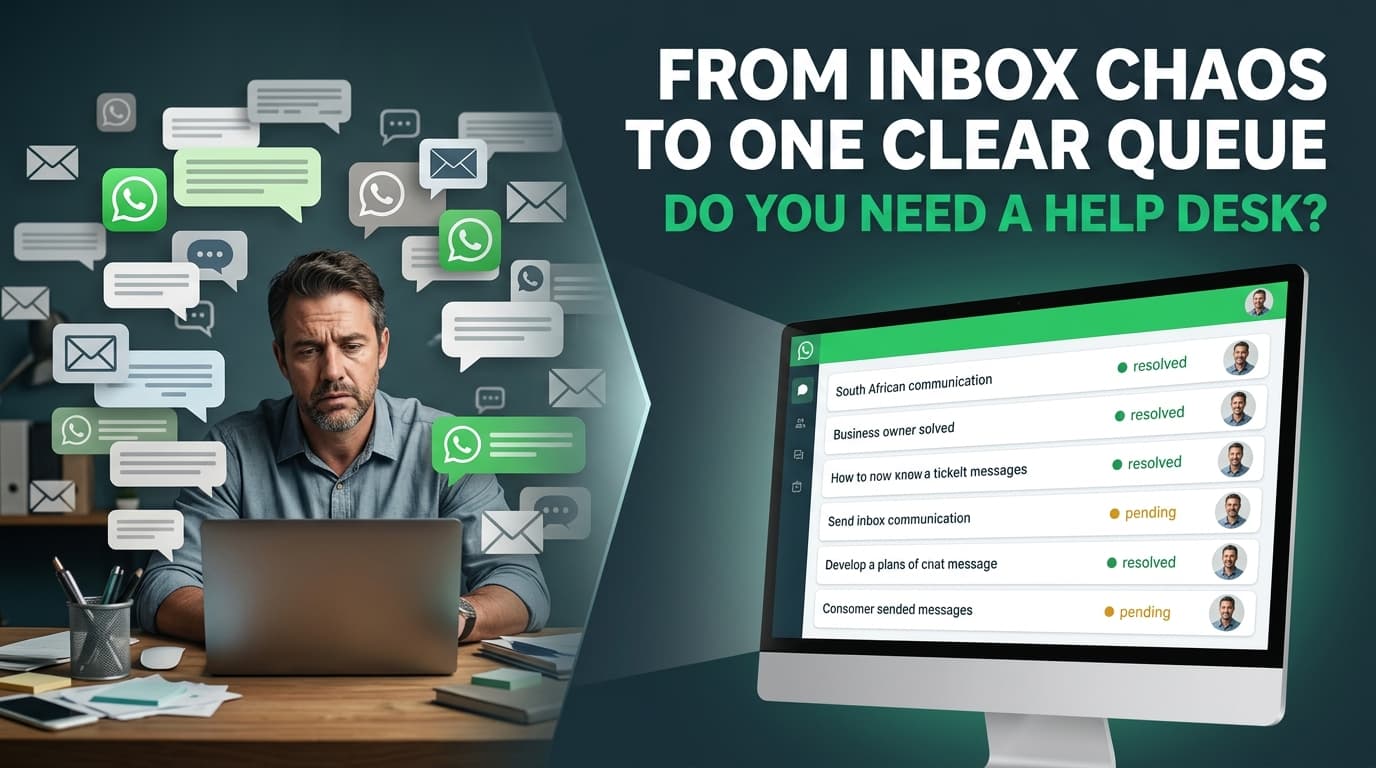
Help desk software turns scattered customer messages — email, WhatsApp, web forms, calls — into tracked tickets with an owner, a deadline and a history. You need one when support volume, staff count or promises made to customers exceed what a shared inbox can honestly hold. For most South African businesses that threshold arrives somewhere around 30–50 queries a week or the third person answering them.
A shared inbox is a room with no shelves. It works beautifully while you own three things. Then you own three hundred, and you spend your day looking for the one you need. That is the moment a help desk stops being software you're "considering" and starts being infrastructure you're missing.
This guide walks through what help desk software actually does, the six signals that say you've outgrown your inbox, indicative costs in rands, and the honest cases where you should not buy one.
What is help desk software?
Help desk software (also called customer support software or a ticketing system) captures every inbound customer query as a ticket — a single record with an owner, a status, a priority, a deadline and a full conversation history. Every reply, note and escalation attaches to that ticket.
Strip away the marketing and there are five things it does that an inbox cannot:
- Assignment. Every query has exactly one name on it. No "I thought you were handling that."
- Status. Open, pending, resolved. You can see, at a glance, what is still owed to whom.
- SLAs. A promised response time that the system enforces and escalates when breached.
- Knowledge base. A public library of answers so customers solve the easy 40% themselves.
- Reporting. First response time, resolution time, ticket volume by cause — the numbers that tell you whether support is a cost or a leak.
That last one is the quiet reason to buy. A help desk doesn't just answer questions faster; it tells you which questions you shouldn't be receiving at all. Ticket data is product feedback wearing a support badge.
Do I need a help desk, or is a shared inbox good enough?
A shared inbox — support@ or info@ with three people looking at it — is a legitimate system. It is free, everyone already knows how to use it, and for a small volume of straightforward queries it is genuinely sufficient. Do not buy software to solve a problem you do not have.
You have outgrown it when any two of the following are true:
- Two people have replied to the same customer. Collision is the classic shared-inbox failure. It looks amateurish and it wastes the one resource you can't buy back.
- Something has fallen through. A customer followed up on an email nobody answered. Not out of malice — it just scrolled off the first screen.
- You cannot answer "how long are we taking?" If you cannot state your average first response time in seconds, you are not managing support, you are surviving it.
- Answers depend on who's in the office. The knowledge lives in one person's head or in their sent folder. When they take leave, quality drops.
- Support has spilled across channels. Email, WhatsApp, Instagram DMs, the contact form, and a cellphone number a customer got three years ago. Nobody has the full picture.
- You've promised something you can't measure. "We respond within 24 hours" on your website is a commitment. Without a system enforcing it, it's a hope.
One of these is a bad week. Two or more is a structural problem, and structural problems get worse with growth, never better.
What does help desk software cost in South Africa?
Nearly all help desk tools are priced per agent, per month — an agent being anyone who answers tickets. That makes the cost predictable and it makes the maths easy: multiply by your support headcount, then by twelve.
The table below shows indicative list pricing on annual billing. Most vendors publish in US dollars; the rand figures below are converted at roughly R16.35 to the dollar (the rate at time of writing, July 2026) and are illustrative only — currency moves, and so does vendor pricing.
| Tier | What you get | Typical price (per agent/month) | Approx. ZAR |
|---|---|---|---|
| Free | Basic email ticketing, tags, a simple help centre. No SLAs, no automation. Agent caps apply (Zoho Desk: 3 agents; Freshdesk: limited and time-boxed). | $0 | R0 |
| Entry | Real ticketing, automations, SLAs, basic reporting. Suits a 2–5 person support function. | ~$14–$25 | ~R230–R410 |
| Mid | Omnichannel (email, chat, WhatsApp), knowledge base, custom reporting, integrations. | ~$40–$100 | ~R650–R1,635 |
| Enterprise / suite | Advanced routing, workforce management, AI assistants, deep analytics. | ~$89–$150+ | ~R1,455–R2,450+ |
Three cost traps worth naming before you sign anything:
- Monthly billing costs more. Paying month-to-month rather than annually typically adds 15–25% per seat.
- AI add-ons are priced separately. Copilot-style assistants are usually a per-agent surcharge on top of the base plan — often $29–$50 per agent per month — not an included feature.
- Seat minimums. Some enterprise tiers enforce a floor (HubSpot's Service Hub Enterprise requires ten seats), which quietly converts a "R1,600 per agent" plan into a R16,000 commitment.
For a three-person support team on a mid-tier plan, budget in the region of R25,000–R60,000 a year, all in. That is not a rounding error for a growing South African business — which is exactly why the "do I need this?" question deserves an honest answer before the "which one?" question.
Not sure whether your support load justifies a dedicated tool? Book a no-obligation discovery call. We'll look at your actual volume and channels and tell you plainly whether you need to buy, build, or simply tidy up what you have.
What should a South African business look for specifically?
The generic feature lists are the same everywhere. Three things matter more here than the vendor comparison sites will tell you.
WhatsApp is not an optional channel
South Africa is one of the most WhatsApp-saturated markets on earth. Meltwater's 2025 Digital Report puts WhatsApp usage at roughly 96% of South African internet users — ahead of Facebook, Instagram and TikTok — and South Africans spend more time in the app per month than users in any other measured country. Local retailers, insurers and telcos already run full-service support through it.
If your support software cannot receive, assign and track a WhatsApp conversation as a ticket, it is solving last decade's problem. Ask the vendor specifically about the WhatsApp Business API — not "we integrate with WhatsApp," but how tickets are created, threaded and closed.
POPIA changes what "just store everything" means
Support tickets are a magnet for personal information: ID numbers, addresses, account details, sometimes payment or health data. Under POPIA, that data must be collected for a defined purpose, kept secure, and not retained longer than necessary.
Practical questions for any vendor:
- Where is the data hosted, and can you get a data processing agreement?
- Can you set retention rules and delete a customer's data on request?
- Who on your team can see what — is there field-level permission control?
We've written a fuller practical guide to POPIA compliance for business software if you want the detail. The short version: a help desk is a personal-information store whether you designed it that way or not, and you are accountable for it.
Support data is worthless if it's stranded
The most common and most expensive mistake is buying a support tool that lives in its own universe. The agent answering a query cannot see the customer's open invoice. The salesperson chasing a renewal cannot see that the customer has logged four angry tickets this month. The founder's dashboard shows revenue and pipeline but not churn risk.
Disconnected tools don't just annoy staff — they hide the story. Support tickets are churn signals. They are product roadmap input. They belong next to your sales pipeline and on your executive dashboard, not in a silo with a separate login.
Standalone help desk vs support inside your business platform
| Standalone help desk | Support inside a Business OS | |
|---|---|---|
| Best for | Support-heavy businesses (high ticket volume, dedicated support team) | Businesses where support is one of several connected functions |
| Customer context | Whatever you sync via integrations | Native — invoices, deals, history in one record |
| Cost | Separate per-agent subscription | Usually included in the platform |
| Setup | Fast; deep feature set out the box | Fast; fewer bells, far less plumbing |
| Risk | Becomes another silo; integration debt grows | May lack advanced routing/workforce features at very high volume |
If you run a 20-agent contact centre, buy the specialist tool. If you're a 5–50 person agency or growing business where the same customer appears in your sales pipeline, your invoicing and your inbox, the specialist tool is the wrong shape — you'll spend more time syncing it than using it.
Syniq's Business OS takes the second path: Support sits alongside Sales & CRM, Operations, Marketing and tax-compliant Finance in one system, so the person answering the ticket can see the invoice, and the executive dashboard can see the ticket. Pricing is here.
When should you build custom support software instead?
Rarely — and be suspicious of anyone who tells you otherwise. Ticketing is a solved problem, and rebuilding it from scratch is a way of spending six figures to arrive where a R400-a-month subscription already is.
Build when your support workflow is your product or your moat:
- Support runs through a regulated or unusual process — a claims workflow, a compliance-audited approval chain, a multi-party dispute flow — that no off-the-shelf status field models correctly.
- Support must sit inside a customer portal you already own, with your data, your permissions and your branding, and bouncing customers to a third-party widget breaks the experience.
- The volume is so specific that generic per-agent pricing is punitive relative to a built asset you own outright.
That's the honest test, and it's the same build vs buy logic we apply to every project. If a subscription solves it, buy the subscription. If it doesn't, we design and build the thing that does — Next.js, TypeScript, Supabase, in-house in Cape Town, with weekly demos so you're never surprised.
Frequently asked questions
What is the difference between a help desk and a CRM? A CRM tracks the relationship and the revenue — contacts, deals, pipeline. A help desk tracks the problem and the promise — tickets, SLAs, resolutions. They answer different questions about the same customer, which is precisely why they work best connected rather than as separate logins.
How many support requests justify buying help desk software? There's no universal number, but the practical threshold most businesses hit is around 30–50 queries a week, or the moment a third person starts answering them. Below that, a disciplined shared inbox with clear ownership rules is usually fine.
Is free help desk software good enough? For one to three agents with simple email-only support, yes — Zoho Desk's free tier supports three agents indefinitely. You give up SLAs, automation and meaningful reporting, which are the features you'll want the moment support gets serious. Treat free as a trial of the workflow, not a destination.
Can help desk software handle WhatsApp in South Africa? The better platforms do, via the WhatsApp Business API — but implementations vary widely. Given that WhatsApp is the dominant messaging channel in South Africa, ask any vendor to demonstrate a WhatsApp conversation becoming a properly assigned, tracked and closable ticket before you commit.
Does help desk software need to be POPIA compliant? The software doesn't carry the obligation — you do. As the responsible party, you must ensure personal information in your tickets is lawfully collected, secured, retained only as long as necessary, and deletable on request. Choose a vendor who will sign a data processing agreement and give you retention and permission controls.
Should I build my own support system? Almost never. Ticketing is commoditised and cheap. Build only when your support process is genuinely non-standard — a regulated claims flow, a bespoke customer portal, a workflow that off-the-shelf status fields cannot model. Otherwise buy, and put the saved budget where it actually differentiates you.
The bottom line
Support software is not about being fancier. It's about keeping the promises you've already made — the "we'll get back to you", the "someone's looking into it", the 24-hour reply on your contact page. A shared inbox lets you make those promises. A help desk lets you keep them, and shows you the receipt.
If you're weighing a subscription against a build, or trying to work out whether your support belongs in a standalone tool or alongside the rest of your operations, that's a thirty-minute conversation, not a six-month project.
Book a discovery call — no obligation, no pitch deck. We'll map your actual support flow and tell you the shortest honest path to fixing it. Or take a look at how Business OS puts Support, Sales, Operations and Finance in one system.
Syniq (Pty) Ltd is a Cape Town software company. We build custom software, web and mobile applications, and Business OS — an all-in-one operations platform for growing South African businesses.