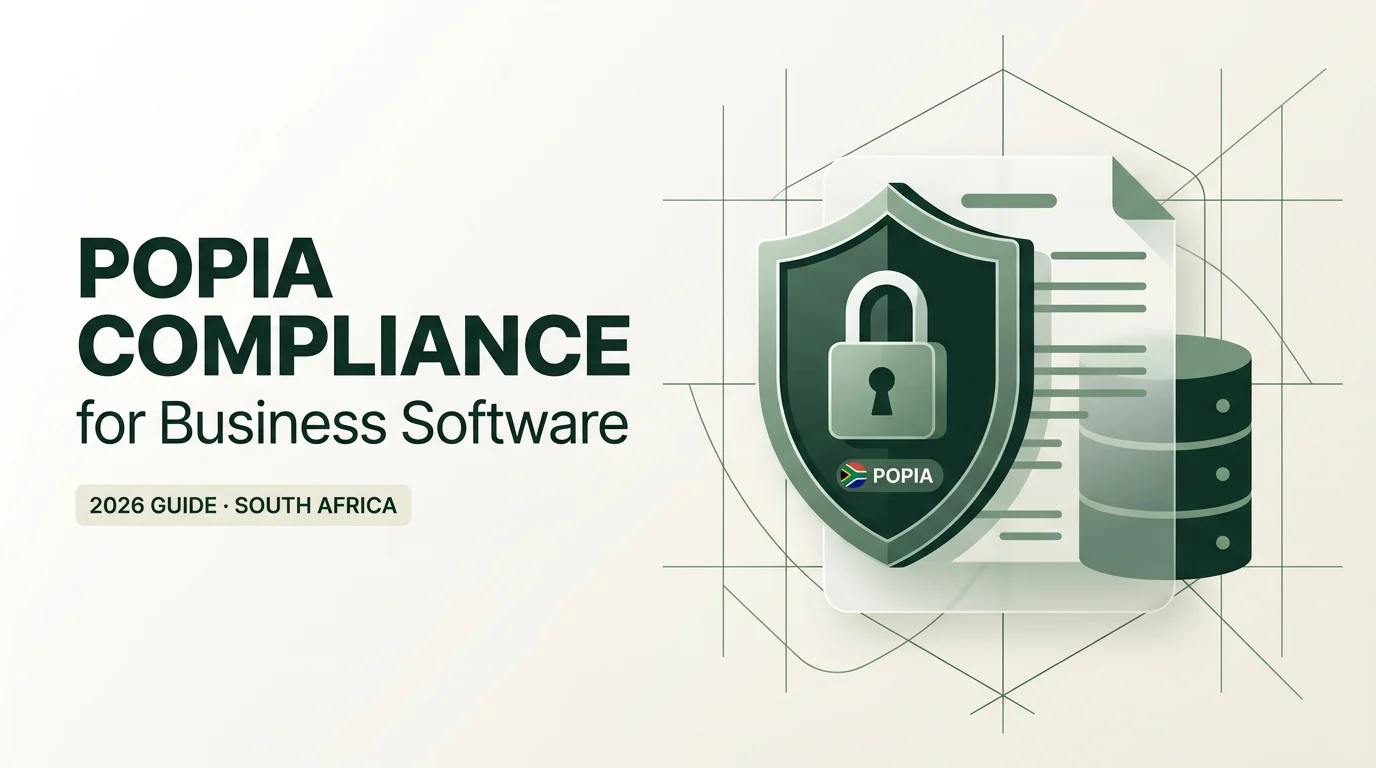
POPIA compliance for business software means the tools you use to collect and process personal information must meet the Protection of Personal Information Act's eight conditions — especially the Section 19 security safeguards like encryption, access control and audit logs. The law makes you, not your vendor, legally accountable for that data, even when someone else processes it on your behalf.
If your business runs on a CRM, an accounting package, a help desk or a marketing platform, you are processing personal information every day — names, ID numbers, banking details, contact records. Since 1 July 2021, South African law has held you responsible for protecting it. This guide explains what POPIA actually requires from the software you buy or build, who carries the liability, and how to evaluate a vendor before you trust them with your customers' data.
What is POPIA compliance for business software?
POPIA — the Protection of Personal Information Act — is South Africa's data protection law. It commenced on 1 July 2020 with a one-year grace period, so it has been fully enforceable since 1 July 2021. It governs how any organisation collects, stores, uses and shares the personal information of living people (and, in some cases, existing companies).
POPIA uses two key roles:
- Responsible party — the organisation that decides why and how personal information is processed. That's you.
- Operator — a third party that processes personal information on your behalf, under contract. Your software vendors and cloud providers are usually operators.
"Compliance for business software" sits at the intersection of these roles. The software is the machinery that does the processing; you are the one the law holds accountable for it. A tool can make compliance dramatically easier — or it can quietly create your biggest exposure. When your sales, finance, support and marketing data lives in one governed platform like a Business OS, the controls POPIA expects are consistent across every function. When it's scattered across a dozen disconnected apps, each one becomes a separate risk to secure, document and defend.
What are the eight conditions for lawful processing?
POPIA is built on eight conditions for lawful processing. Every one of them touches the software you use. Here's what each condition means in practice for a business tool that handles personal data.
| # | Condition | What it means for your software |
|---|---|---|
| 1 | Accountability | You must be able to demonstrate compliance. Your system should log activity and let you produce records on demand. |
| 2 | Processing limitation | Data is collected lawfully and minimally, with consent or another legal basis. Forms and fields shouldn't hoover up more than you need. |
| 3 | Purpose specification | Collect for a specific, stated purpose — and set retention limits. Your software should support data retention and deletion. |
| 4 | Further processing limitation | Don't repurpose data in ways incompatible with why it was collected. Integrations that pipe data elsewhere need checking. |
| 5 | Information quality | Records must be accurate and up to date. Deduplication and easy editing matter here. |
| 6 | Openness | People must know what you hold and why. Your privacy notices and consent capture live partly in your tools. |
| 7 | Security safeguards | Appropriate technical and organisational measures to protect data. This is where software choices matter most (see below). |
| 8 | Data subject participation | People can ask what you hold, and request correction or deletion. Your system must be able to find and export their record. |
Conditions 7 and 8 are where most software either shines or fails. If a customer emails tomorrow asking exactly what personal information you hold on them, could your current tools answer that in minutes — or would it take a frantic afternoon of searching spreadsheets? POPIA assumes the former.
Which POPIA security safeguards must your software support?
Condition 7 is spelled out in Section 19. It requires the responsible party to secure the integrity and confidentiality of personal information by taking "appropriate, reasonable, technical and organisational measures" to prevent loss, damage, unauthorised destruction and unlawful access. In practice, Section 19 asks you to identify foreseeable risks, put safeguards in place against them, verify those safeguards work, and keep them updated as new risks emerge.
Software can't do all of that for you — but the right software does the heavy lifting on the technical side. When you're assessing a business tool, these are the safeguards to look for:
- Encryption in transit and at rest — data is unreadable if intercepted or if a disk is stolen.
- Role-based access control (RBAC) — each user sees only the records their role needs, not the whole database.
- Detailed audit logs — a tamper-resistant record of who accessed or changed what, and when. This is what makes accountability provable.
- Breach detection and alerting — you can't report a breach you never noticed.
- Data residency or documented cross-border safeguards — you know which country your data physically lives in, and whether any transfer abroad is lawful under POPIA.
- Backups and recovery — protection against loss and ransomware, not just theft.
- Multi-factor authentication and strong session controls — the front door is genuinely locked.
Section 19 also says you must have "due regard to generally accepted information security practices." Translated: doing the bare minimum isn't a defence. This is why security has to be a design decision rather than an afterthought — in Syniq Business OS, roles and business units limit who sees which records and sign-in supports two-factor authentication, and our POPIA policy sets out how we handle personal information.
Vetting a new system or replacing a leaky one? Book a no-obligation discovery call and we'll map your data flows against POPIA's eight conditions — so you know exactly where you stand before you sign anything.
Who is responsible — you or your software vendor?
This is the question that catches businesses out. The short answer: you remain responsible, even when a vendor does the processing.
Under Section 20 and Section 21, when an operator processes personal information on your behalf, you must have a written contract — an operator agreement — that binds them to the same Section 19 security obligations that apply to you. That contract must also require the operator to tell you immediately if there's any unauthorised access to or disclosure of your data.
Critically, outsourcing the work does not outsource the liability. If your payroll processor, email platform or cloud host suffers a breach, you — the responsible party — are still on the hook to the Information Regulator and to the people whose data was exposed. That's why a vendor's willingness to sign a proper operator agreement isn't a nice-to-have; it's a filter. If a supplier won't commit in writing to protecting your data, that tells you what you need to know.
Data residency deserves a special mention here. Some tools marketed as "local" run their interface in South Africa while storing the actual data in Frankfurt, Dublin or Virginia. Cross-border transfers are allowed under POPIA, but only under specific conditions. Cloud regions such as AWS Cape Town and Azure South Africa North make genuine local residency possible — but you have to ask where your data lives rather than assume. For data-heavy functions like tax-compliant invoicing and accounting, where you're storing banking details and financial records, that question matters even more.
What happens if you get POPIA wrong?
POPIA has real teeth, and the Information Regulator has started using them.
For serious offences, the penalties are an administrative fine of up to R10 million, imprisonment of up to 10 years, or both. The Regulator can issue an administrative fine through an infringement notice without going to court first. Beyond the fine, there's the reputational damage, the cost of notifying affected customers, and potential civil claims.
This isn't theoretical. In 2023 the Information Regulator issued its first fine — R5 million — to the Department of Justice and Constitutional Development. The trigger was a 2021 ransomware attack that locked the department out of its systems and compromised files containing names, banking details and contact information. The fine wasn't for the attack alone; it was for failing to comply with an enforcement notice to put basic technical measures — like renewing anti-virus, intrusion detection and security-monitoring licences — back in place. The lesson is blunt: neglected security safeguards, not just dramatic hacks, are what get penalised.
Section 22 adds a duty that surprises many owners: breach notification. Once you become aware of a security compromise involving personal information, you must notify both the Information Regulator and the affected people as soon as reasonably possible. You cannot meet that obligation if your software can't tell you what was accessed. Audit logs and breach detection aren't bureaucratic extras — they're what make lawful, timely reporting possible.
How to evaluate a vendor for POPIA compliance
There is no official "POPIA certified" stamp, so the responsibility to assess a vendor falls on you. Use this checklist as a shortlist filter. A trustworthy vendor answers "yes" — clearly and in writing — to all of it.
| Evaluation question | POPIA-ready answer | Red flag |
|---|---|---|
| Is data encrypted in transit and at rest? | Yes, by default | "It's on our roadmap" |
| Is access role-based and least-privilege? | Granular roles and permissions | Everyone shares one admin login |
| Are there detailed, exportable audit logs? | Full activity history | No logs, or logs you can't access |
| Where is our data physically stored? | Named region, documented | Vague or "we're not sure" |
| Will you sign an operator agreement? | Yes, standard practice | Refusal or endless delay |
| How are breaches detected and reported to us? | Defined process and SLA | No breach process at all |
| Can we export or delete a person's data on request? | Self-service or fast turnaround | Manual, slow, or impossible |
Two practical notes. First, favour consolidation. Every extra tool that touches personal data is another operator agreement to sign, another attack surface to secure, and another audit trail to maintain. Fewer, well-governed systems are easier to keep compliant than a sprawl of point solutions. Second, remember that off-the-shelf tools give you the vendor's controls as-is, while a custom-built system lets you design residency, access rules and retention around your exact obligations. Neither is automatically "more compliant" — but they demand different questions.
How Syniq approaches POPIA
We build for South African businesses, from an in-house Cape Town team, which means POPIA isn't a foreign standard we retrofit — it's the baseline we design to. Whether you buy our Business OS to run sales, finance, marketing and support in one governed platform, or commission a bespoke build, the same principles apply: access by role, two-factor sign-in, and each organisation's records kept apart. Our approach to POPIA is documented openly on our POPIA page.
Compliance is ultimately about trust. The businesses that treat data protection as a feature — not a burden — are the ones customers feel safe handing their information to. That's a competitive advantage, not just a legal box to tick.
Want to know where your current stack stands? Book a free discovery call and we'll help you close the gaps — whether the answer is a build, a switch, or simply tightening what you already have.
Frequently asked questions
Is POPIA compliance mandatory for all South African businesses? Yes. POPIA applies to any responsible party in South Africa that processes personal information, with limited exceptions, and it has been fully enforceable since 1 July 2021. Size is no exemption — a two-person agency handling client data carries the same core duties as a large firm, scaled to what's reasonable for its circumstances.
Does using POPIA-compliant software make my business compliant? No. Software is a tool, not a certificate. The right platform makes meeting Section 19 far easier, but you remain the responsible party. You still need a registered Information Officer, a lawful basis for processing, privacy notices, a breach response plan, and operator agreements with every vendor that touches your data.
What makes software "POPIA-compliant"? There is no official POPIA certification. In practice, look for encryption in transit and at rest, role-based access control, detailed and exportable audit logs, breach detection, clear data residency or documented cross-border safeguards, and a vendor willing to sign an operator agreement confirming their Section 19 obligations.
Who is responsible if my software vendor has a data breach? You are. Under Sections 20 and 21, an operator processes data on your behalf under a written contract, but the responsible party remains liable for protecting that information. That's why the operator agreement — and the vendor's breach-notification commitments — matter so much.
What are the penalties for POPIA non-compliance? Serious offences carry an administrative fine of up to R10 million, imprisonment of up to 10 years, or both. The Information Regulator can impose fines via an infringement notice without a court order. Its first fine, R5 million, was issued to the Department of Justice in 2023 for failing to maintain basic security measures.
Do I have to report every data breach? Under Section 22, you must notify the Information Regulator and the affected people as soon as reasonably possible after becoming aware of a security compromise involving personal information. Software with breach detection and audit logs is what makes it possible to scope the breach accurately and report it on time.