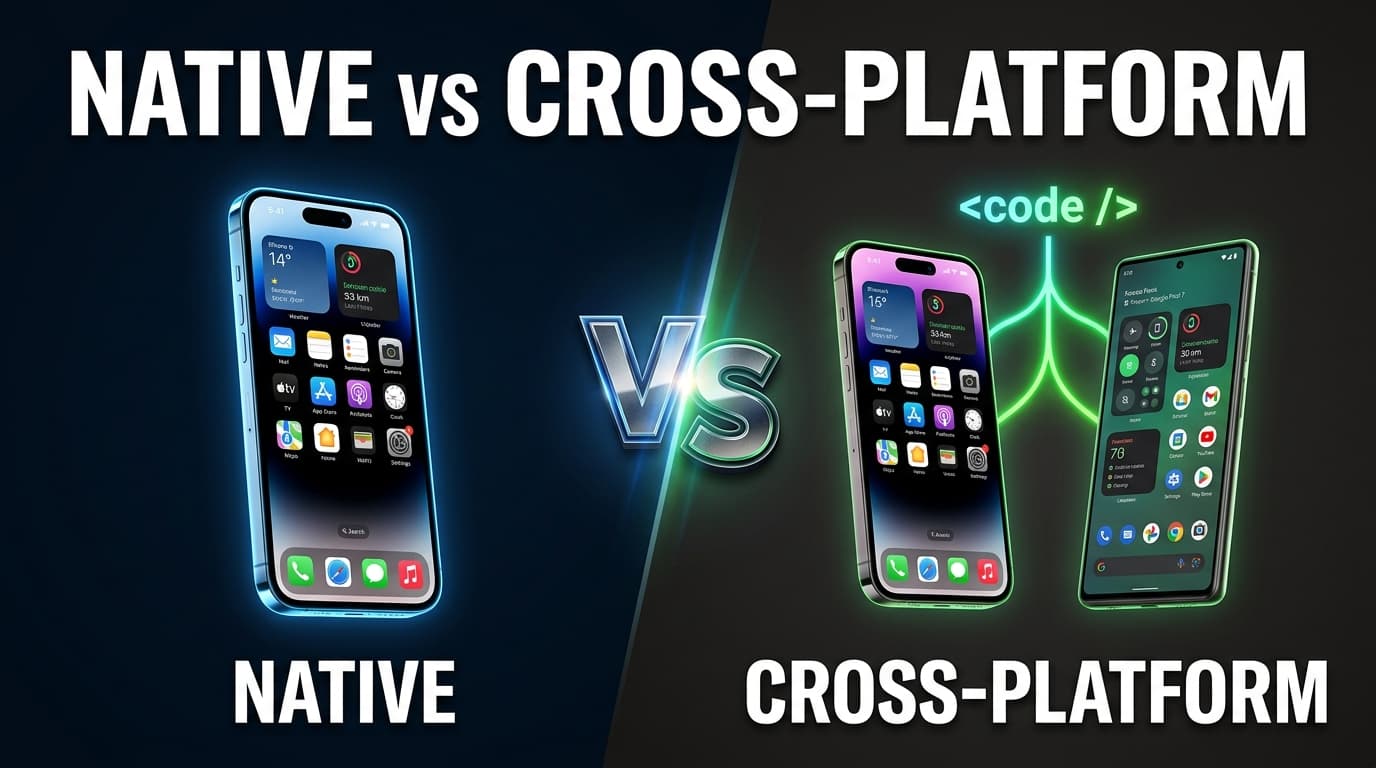
Native apps are built separately for iOS and Android using each platform's own tools, delivering peak performance. Cross-platform apps use one codebase — usually React Native or Flutter — to run on both, cutting cost and time by roughly 30–60%. For most South African businesses, cross-platform is the smart default; native wins for graphics-heavy or hardware-intensive apps.
Choosing between native and cross-platform is the first real fork in the road when you commission a mobile app — and it shapes your budget, your timeline, and how fast you can ship updates for years afterward. Get it right and you reach every customer from one efficient build. Get it wrong and you pay twice for the same app, or box yourself into a stack that fights the product you actually need. This guide gives you a clear decision, grounded in South African market realities.
What is the difference between native and cross-platform apps?
Think of it like building for two different countries with two different languages. A native app is written in each platform's own language, by developers using that platform's own toolkit — Swift or Objective-C in Xcode for iPhone, Kotlin or Java in Android Studio for Android. You build the app twice, once for each store. The payoff is a perfect local accent: full access to every device feature, day-one support for new OS releases, and the smoothest possible performance.
A cross-platform app is written once, in a single codebase, and runs on both iOS and Android. Two frameworks dominate this space:
- React Native (built by Meta) uses JavaScript and TypeScript and renders real native interface components under the hood — the same buttons and lists the operating system draws itself. It's the stack behind Facebook Marketplace, Shopify's mobile apps, Walmart, Discord, and Coinbase Wallet.
- Flutter (built by Google) uses the Dart language and draws every pixel itself through its own rendering engine, giving designers pixel-perfect control across platforms.
Both approaches produce genuine app-store apps that install on a phone. The difference is what happens behind the glass: native writes two specialised builds; cross-platform writes one shared build that speaks to both platforms.
If you're still deciding whether you even need an app versus a website or web app, start with our guide to web app vs website vs mobile app — then come back here to choose how to build it.
Native vs cross-platform: a side-by-side comparison
| Factor | Native (Swift / Kotlin) | Cross-platform (React Native / Flutter) |
|---|---|---|
| Codebases | Two — one per platform | One shared codebase |
| Cost to reach iOS + Android | Highest — you build twice | ~30–60% lower |
| Time to market | Slower — parallel builds | Faster — 30–40% quicker cycles |
| Performance | Peak, especially for heavy graphics | Near-native for most apps in 2026 |
| Hardware & new OS features | Immediate, complete access | Excellent; niche features may need custom modules |
| UI consistency | Tailored per platform | Consistent across both by default |
| Maintenance | Fix and test twice | Fix once, ship to both |
| Over-the-air updates | Limited | Supported (React Native / Expo) |
| Best for | Games, AR/VR, ultra-performance apps | Most business, commerce & service apps |
The single biggest cost lever isn't in this table, though: the expertise of the team you hire. Using a framework your developers already know deeply cuts delivery time by 40–60% regardless of which path you choose. A brilliant cross-platform team will out-deliver a stretched native one, and vice versa.
How much does each approach cost in South Africa?
The clearest way to think about cost is coverage. A native strategy means paying for two apps to reach both audiences. A cross-platform strategy means paying for roughly one and a bit — a shared core plus occasional platform-specific polish. That's where the 30–60% saving comes from, and it compounds: every future feature, bug fix, and OS update also gets done once instead of twice.
As an indicative guide for the South African market, a straightforward cross-platform app typically starts in the low-to-mid hundreds of thousands of rand, while feature-rich apps with custom backends, integrations, and offline support run higher. Native builds targeting both platforms sit meaningfully above that for comparable scope. These are ranges, not quotes — real cost depends on features, integrations, and design complexity, so book a scoping call for a fixed quote. For a full breakdown of what drives the number, see our detailed guide on mobile app development cost in South Africa.
Is cross-platform as good as native in 2026?
For most apps, yes — and the gap that used to exist has narrowed to the point of irrelevance for typical business software. React Native's "New Architecture" (Fabric, JSI and TurboModules) is now the default, replacing the old communication bridge with direct, near-instant calls between JavaScript and native code. Flutter's Impeller engine renders smooth, high-frame-rate animation. The result is that a well-built cross-platform app feels indistinguishable from native to the person holding the phone.
The proof is in production. Walmart runs its mobile commerce on React Native with roughly 95% of its code shared between iOS and Android, and reported performance "nearly identical" to native — smooth animations right through its product grid and checkout. Shopify completed a full migration of its flagship app to React Native, unifying the vast majority of its codebase. Meta ships parts of Facebook, Messenger and Ads Manager on it. When companies at that scale trust one codebase to serve tens of millions of users, a South African SME can build on the same foundation with confidence.
Cross-platform earns its keep beyond raw speed, too. One team maintains the product instead of two. Features land on both stores at the same time. And with over-the-air updates, you can push fixes to users without waiting days for an app-store review — a real advantage when something needs correcting fast.
When should you build a native app instead?
Being honest about the exceptions is what makes the default trustworthy. Native is the right call when the app's core value is raw device performance or deep platform integration:
- Graphically intense apps — 3D games, augmented or virtual reality, or heavy real-time visual processing, where every frame counts.
- Deep hardware work — apps that lean hard on the secure enclave, advanced camera pipelines, or specialised sensors beyond what standard cross-platform modules expose.
- Streaming and media engineering — Netflix, for instance, uses native to fine-tune video playback, offline downloads and adaptive streaming.
- Platform-first UX as a differentiator — when a flawless, platform-native feel is genuinely part of your competitive edge, and you have the budget to build and maintain two apps well.
Notice the pattern: these are cases where the phone's hardware is the product. For a CRM, a booking app, a field-service tool, a delivery tracker, a loyalty app, or an internal operations app — the workhorses of South African business — cross-platform covers the requirement comfortably and for less.
Not sure which camp your idea falls into? That's exactly the conversation to have on a no-obligation discovery call — we'll tell you plainly which approach fits, even when that's native.
Which should a South African business build?
Here's the local reality that settles most decisions. As of May 2026, South Africa's mobile audience splits roughly 77% Android and 23% iOS (Statcounter). Android leads, but iOS is far from a rounding error — nearly one in four South African phone users is on an iPhone, a notably higher share than the African average, and iPhone users often skew toward higher-spending urban customers. Building for only one platform leaves real revenue on the table.
That single fact is why cross-platform is the smart default here: it lets you reach that full 77%-plus-23% from one build, one budget, and one team. You cover the whole market without paying to construct and maintain two separate apps.
Use this quick decision guide:
| Your situation | Recommended path |
|---|---|
| Commerce, services, bookings, CRM, internal tools | Cross-platform (React Native) |
| Tight budget, need to reach both Android & iPhone | Cross-platform |
| MVP or first version, speed to market matters | Cross-platform |
| 3D game, AR/VR, or graphics-heavy product | Native |
| Deep sensor / secure-hardware requirements | Native (or cross-platform with custom modules) |
| Platform-perfect UX is your competitive edge | Native |
For a genuinely complex product, there's also a middle path: build cross-platform for speed and reach, then drop into custom native modules only for the one or two features that truly need it. You get most of the savings without compromising the parts that matter. If your ambitions stretch beyond mobile into web and internal systems too, that's where custom software and web development join the same roadmap.
The Syniq approach to mobile apps
At Syniq, we build mobile apps with React Native — one codebase that reaches every South African customer, on Android and iPhone alike. Our stack pairs React Native with a Supabase and PostgreSQL backend, so your app, your data, and your business logic are engineered as one coherent system rather than stitched-together parts.
You work with an in-house Cape Town team — no offshore handoffs, no lost-in-translation briefs. You see weekly demos, so progress is visible and course-corrections are cheap. And every build is engineered to POPIA-grade security standards from day one, because protecting your customers' data isn't a feature you bolt on later. The outcome is simple to state plainly: a fast, reliable app that reaches your whole market, built once and maintained sensibly.
Frequently asked questions
What is the difference between native and cross-platform apps? Native apps are built separately for each platform using its own tools (Swift for iOS, Kotlin for Android), giving peak performance and full hardware access. Cross-platform apps use one shared codebase — typically React Native or Flutter — to run on both, saving significant cost and time.
Is React Native as good as native in 2026? For the vast majority of business apps, yes. React Native's New Architecture delivers near-native performance, and companies like Walmart, Shopify and Meta run it in production for tens of millions of users. Native only pulls clearly ahead for graphics-heavy, AR/VR, or deep-hardware apps.
Which is cheaper — native or cross-platform? Cross-platform is cheaper for reaching both iOS and Android, typically by 30–60%, because you build and maintain one codebase instead of two. The savings continue over the app's life, since every update is done once rather than twice.
When should I choose native over cross-platform? Choose native when raw performance or deep platform integration is the product itself — 3D games, augmented reality, advanced camera or sensor work, or streaming engineering. For most commerce, service and operations apps, cross-platform is the better value.
Do I need separate apps for Android and iPhone in South Africa? No. A cross-platform build reaches both from one codebase, which matters because South Africa's market is roughly 77% Android and 23% iOS — you want to serve both without paying for two apps.
How long does a cross-platform app take to build? It varies with scope, but cross-platform cycles typically run 30–40% faster than building two native apps. A focused first version can reach the stores in a matter of weeks to a few months. Book a scoping call for a timeline matched to your features.
Ready to build once and reach every customer? Syniq designs and builds mobile apps for South African businesses — one efficient codebase, an in-house Cape Town team, weekly demos, and POPIA-grade security. Book a free discovery call and we'll recommend the right approach for your product — cross-platform or native — with a clear, fixed quote.