CRM software "similar to Salesforce" can mean three different things: a CRM as deep as Salesforce, a CRM with the same pipeline but less admin, or one that does the job for less. Pick which of the three you want before you compare names, because the best match for each is a different product.
Salesforce is the CRM other CRMs are measured against. That makes the search useful and also vague. A reader who wants an enterprise platform and a reader who wants a cheaper pipeline type the same words.
What "similar to Salesforce" can mean
- The same depth. You want custom objects, a large app marketplace and strong reporting. Few products match this, and they cost similar money and admin time.
- The same pipeline, simpler. You want leads, deals, stages and quotes, without a consultant or an admin. Most small teams want this.
- The same job, for less. You want a CRM that fits a rand budget. Per-user US-dollar pricing is the usual reason people leave.
What Salesforce costs
Salesforce's Sales pricing page (opened 8 November 2026) lists these editions, per user per month in US dollars:
| Edition | Price per user per month | Billing |
|---|---|---|
| Free Suite | $0 | Not stated |
| Starter Suite | $25 | Monthly or annually |
| Pro Suite | $100 | Annually |
| Core | $195 | Annually |
| Advanced | $395 | Annually |
| Max | $550 | Annually |
The page says the prices are for information and may change. Five people on Pro Suite is five times $100 a month, paid in US dollars. How Much Does a CRM Cost in South Africa? (2026 Guide) shows what that comes to in rands.
CRMs that are similar, by what you want
Zapier's guide to Salesforce alternatives (opened 8 November 2026) matches seven CRMs to a use, not one overall ranking: HubSpot for a full-featured replacement, Pipedrive for a simple sales pipeline, Zoho CRM for affordability, Vtiger for small businesses, Attio for an AI-native design, Nutshell for managing a sales team, and Copper for Google Workspace users. The page does not cover South Africa, rand prices or where your data sits, so check those yourself.
If you want the same breadth. HubSpot is the usual first name. Its pricing page (opened 8 November 2026) lists a free plan for up to 2 users and paid plans in US dollars per seat, with the lowest paid price shown as a limited-time offer for new customers.
If you want a simpler pipeline. Zapier names Pipedrive as the pick for sales simplicity. Check whether invoicing, support and project tools are part of the product or separate ones you would add.
If you want a lower price. Zoho CRM is the one Zapier picks for affordability. Whatever you choose, count every user you will add and ask whether billing is in rands or dollars.
For a side-by-side with data location, WhatsApp and accounting links, read Best CRM Software in South Africa for Small Business (2026). If you want the page that compares Syniq with Salesforce line by line, see Syniq vs Salesforce.
Where Syniq fits
Syniq is a CRM that is also an accounting, jobs and support system. Syniq Sales has:
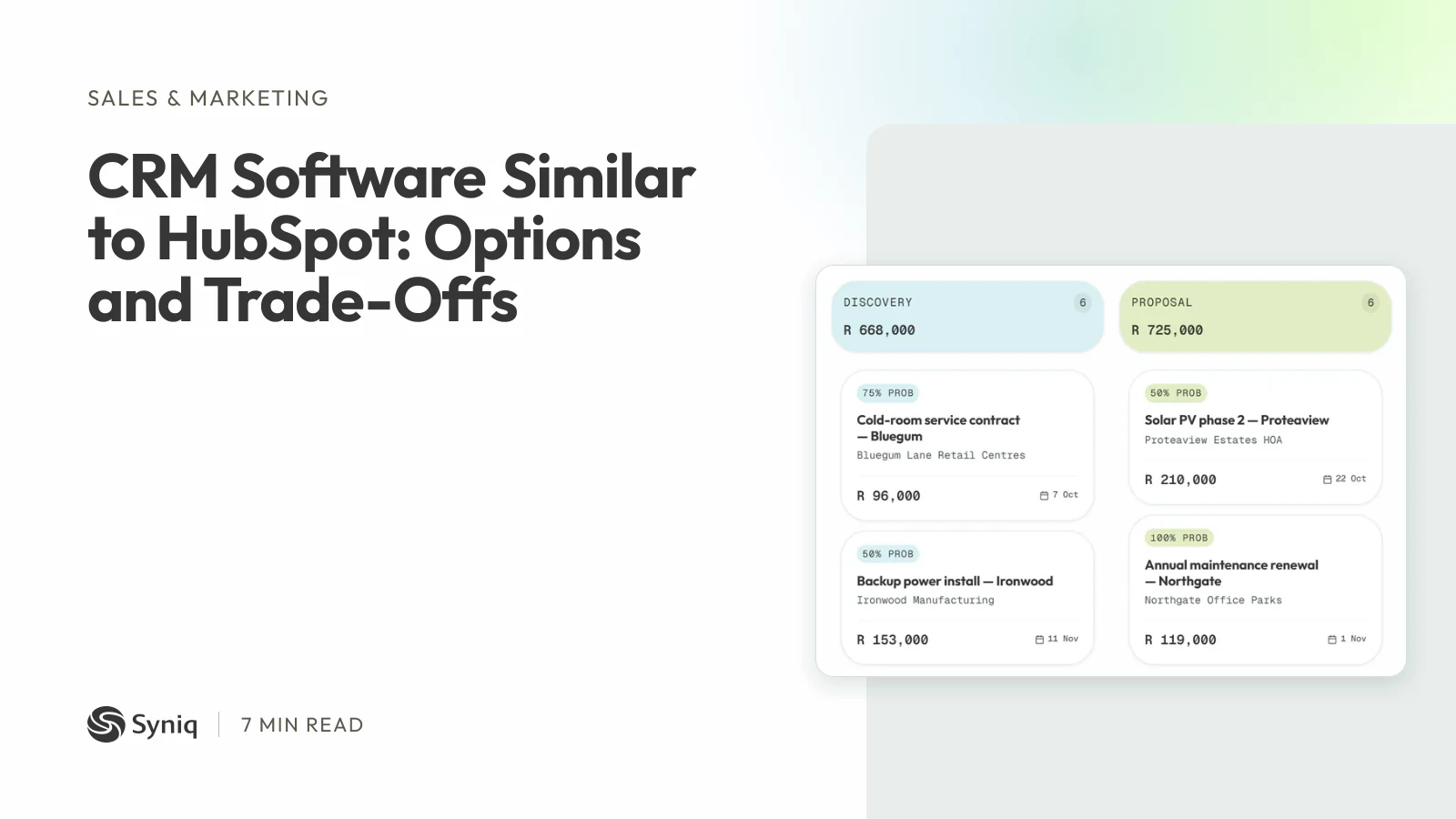
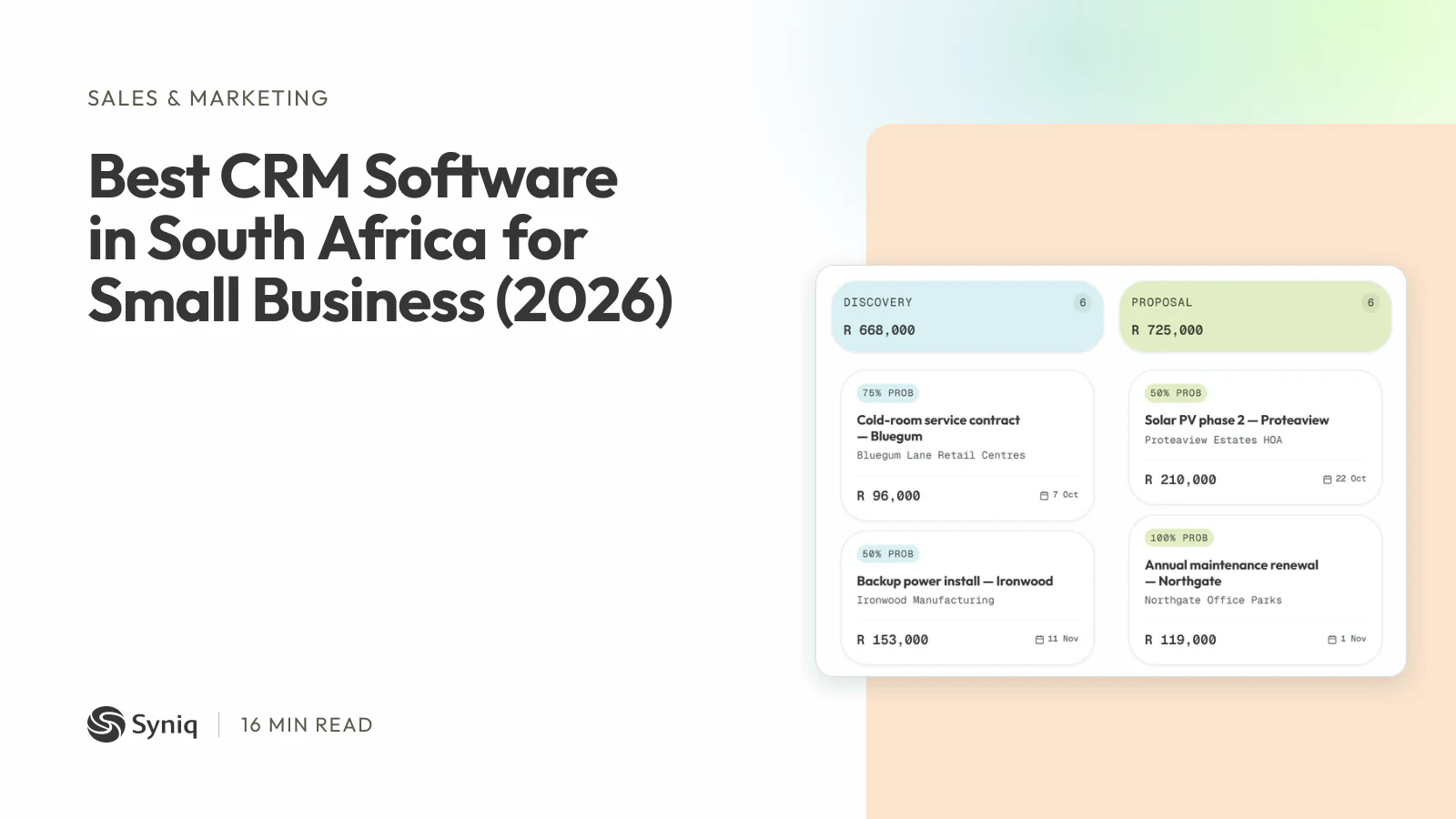
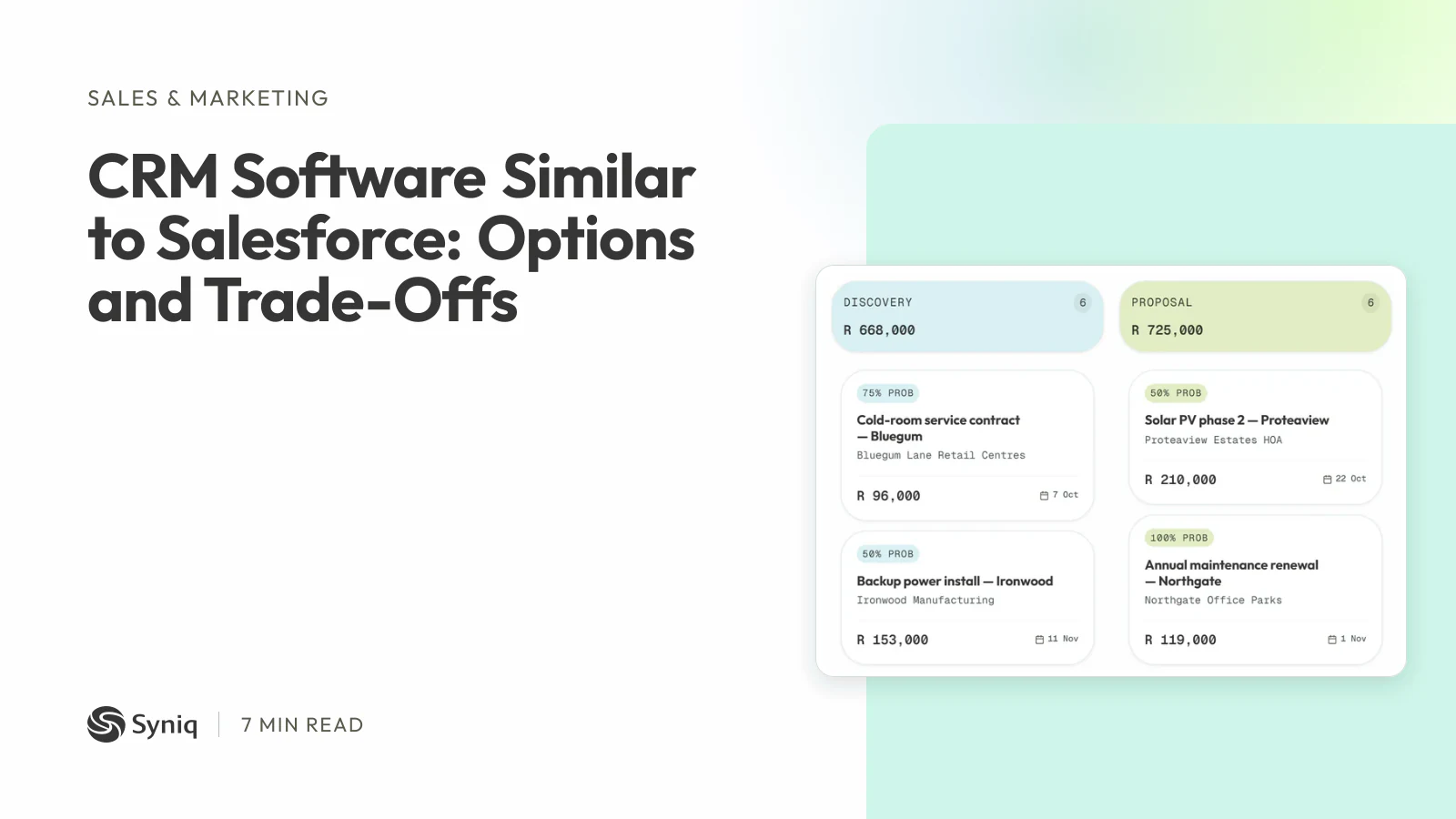
- A pipeline you can drag, with stages you add, rename, reorder and remove.
- Client profiles that show each client's deals, jobs, invoices, tickets and contacts, according to each person's role.
- Quotes on the deal, and when the client accepts, the invoice is generated from the quote.
- Deal approvals: deals worth more than R 50,000 wait for an approver.
Starter costs R 47 a month, billed annually, for one user and any two apps. Professional costs R 159 for one user and all six apps. Business costs R 559 for five users and all six apps. Syniq is not VAT-registered, so no VAT is added.
It is not as deep as Salesforce, and it is worth being plain about that:
- Syniq has no custom objects and no app marketplace. Its integrations are QuickBooks Online and Jira.
- Syniq connects to QuickBooks Online, not to Xero or Sage.
- Syniq has no e-signature, and the client cannot accept a quote online. A team member marks it accepted.
- Syniq has no product configurator, so it is not CPQ software.
- Lead scores follow a fixed rule. They are not AI.
If you need Salesforce-level customisation, stay with a platform built for it. If you want leads, quotes and invoices in one rand-priced system, see Syniq Sales.
How to choose
- Name the likeness you want: depth, a simpler pipeline, or price.
- Count the users in a year, not today, and multiply by the per-user price.
- Ask what billing currency is used and who pays when the rand moves.
- Check the accounting link. If you use Xero or Sage, check that the CRM connects to it.
- Test with your own data. Import clients from a spreadsheet during the trial and build a real quote.
If you are still asking what a CRM is, start with Cloud-Based CRM Software: What It Is and How to Choose. If you want to try Syniq, start a 14-day free trial.