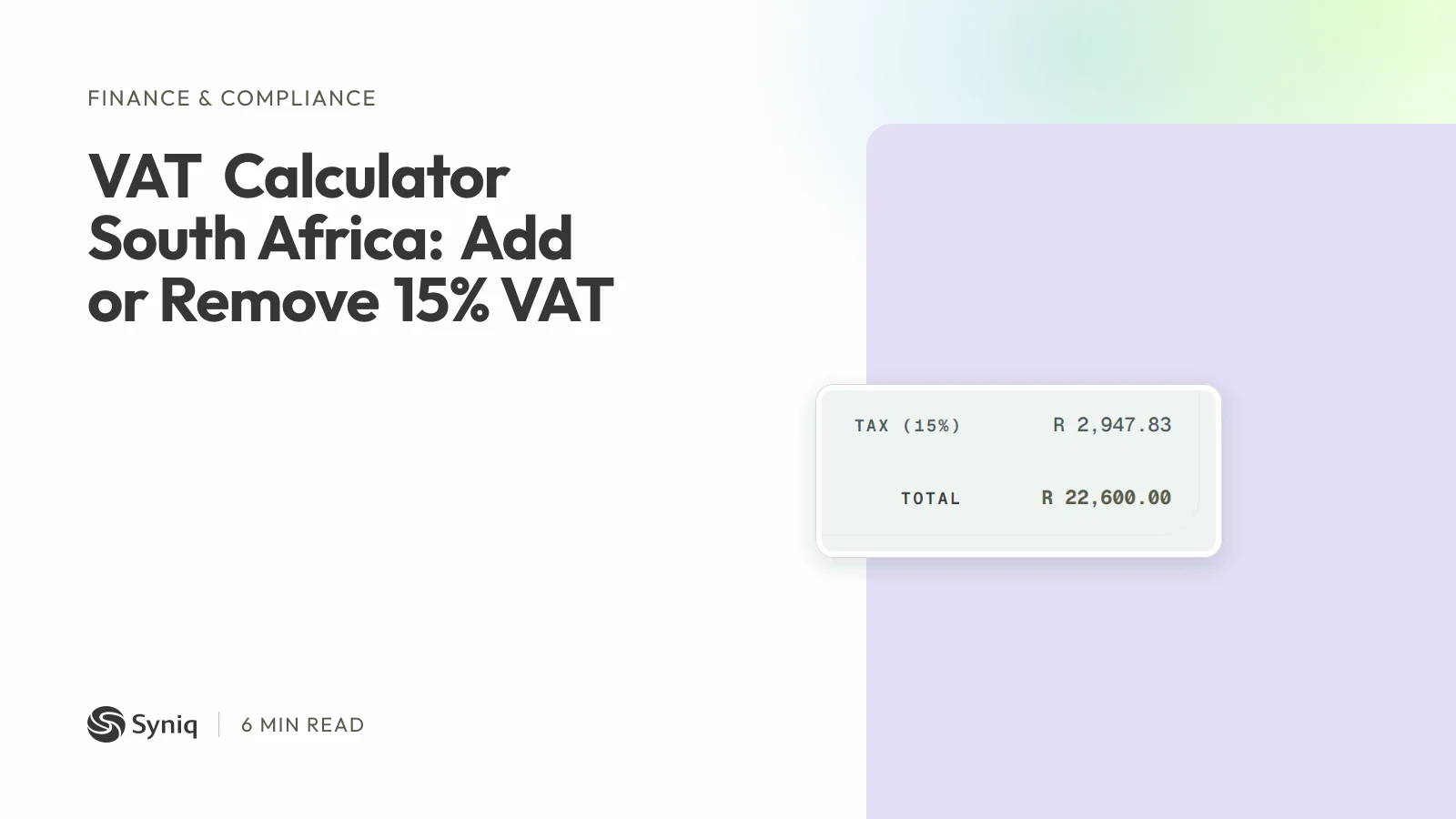
To add 15% VAT to a price, multiply it by 1.15. To take VAT out of a price that already includes it, divide by 1.15. R 1,000 before VAT is R 1,150 with VAT, and R 1,150 with VAT is R 1,000 before VAT. The tables below do the sum for common amounts, and the formulas work for any amount.
South Africa's standard VAT rate is 15%. SARS says VAT "is levied at the standard rate of 15% on the supply of goods and services by registered vendors". Calculator pages online, including QuickBooks and TaxTim, all do one of two sums. This guide gives you both sums, a lookup table for each, and the checks that stop the usual mistakes.
How do you add VAT to a price?
Multiply the price before VAT by 1.15. The VAT on its own is the price before VAT multiplied by 0.15.
- R 2,000 before VAT: R 2,000 × 1.15 = R 2,300. The VAT is R 300.
- R 180 before VAT: R 180 × 1.15 = R 207. The VAT is R 27.
Here is the sum for common amounts:
| Price before VAT | VAT at 15% | Price with VAT |
|---|---|---|
| R 25 | R 3.75 | R 28.75 |
| R 70 | R 10.50 | R 80.50 |
| R 90 | R 13.50 | R 103.50 |
| R 100 | R 15.00 | R 115.00 |
| R 130 | R 19.50 | R 149.50 |
| R 180 | R 27.00 | R 207.00 |
| R 250 | R 37.50 | R 287.50 |
| R 500 | R 75.00 | R 575.00 |
| R 1,000 | R 150.00 | R 1,150.00 |
| R 2,500 | R 375.00 | R 2,875.00 |
| R 5,000 | R 750.00 | R 5,750.00 |
| R 10,000 | R 1,500.00 | R 11,500.00 |
| R 50,000 | R 7,500.00 | R 57,500.00 |
How do you take VAT out of a price?
Divide the price that includes VAT by 1.15. The VAT is the difference between the two.
- R 1,150 with VAT: R 1,150 ÷ 1.15 = R 1,000. The VAT is R 150.
- R 5,750 with VAT: R 5,750 ÷ 1.15 = R 5,000. The VAT is R 750.
Here is the sum for common totals:
| Price with VAT | Price before VAT | VAT at 15% |
|---|---|---|
| R 115 | R 100.00 | R 15.00 |
| R 230 | R 200.00 | R 30.00 |
| R 500 | R 434.78 | R 65.22 |
| R 1,000 | R 869.57 | R 130.43 |
| R 1,150 | R 1,000.00 | R 150.00 |
| R 2,500 | R 2,173.91 | R 326.09 |
| R 5,000 | R 4,347.83 | R 652.17 |
| R 5,750 | R 5,000.00 | R 750.00 |
| R 10,000 | R 8,695.65 | R 1,304.35 |
| R 25,000 | R 21,739.13 | R 3,260.87 |
Why not just take 15% off?
Because the 15% was added to the price before VAT, not to the total. VAT is about 13% of a price that includes it (R 150 of R 1,150). Take 15% off R 1,150 and you get R 977.50, which is R 22.50 too low. Always divide by 1.15.
How do you work out VAT on a phone calculator or in a spreadsheet?
On a phone calculator, type the price, press ×, type 1.15 and press equals to add VAT. Press ÷ instead of × to take VAT out. For the VAT alone, multiply the price before VAT by 0.15.
In Excel or Google Sheets, put the price in cell A2 and use these:
- Add VAT:
=A2*1.15 - VAT on a price before VAT:
=A2*0.15 - Take VAT out:
=A2/1.15 - VAT inside a price that includes it:
=A2-A2/1.15
Round the VAT to the nearest cent with =ROUND(A2*0.15,2), and work out the total as the price plus that rounded VAT, so that the lines on an invoice add up. For example, R 99.99 with VAT is R 86.95 before VAT and R 13.04 VAT.
Which prices carry 15%, and which do not?
Only some supplies carry the standard rate. SARS says "certain supplies are subject to a zero rate, or are exempt from VAT". A zero-rated supply is a sale charged at 0%, and a registered vendor can still claim back the VAT on what it bought to make that sale. An exempt supply carries no VAT, and the vendor cannot claim input tax on what it bought to make it. The calculation above is the standard-rate one, so first check which rate your sale carries. Ask your accountant, or read SARS's VAT pages, before you use 0%.
Do you have to charge VAT?
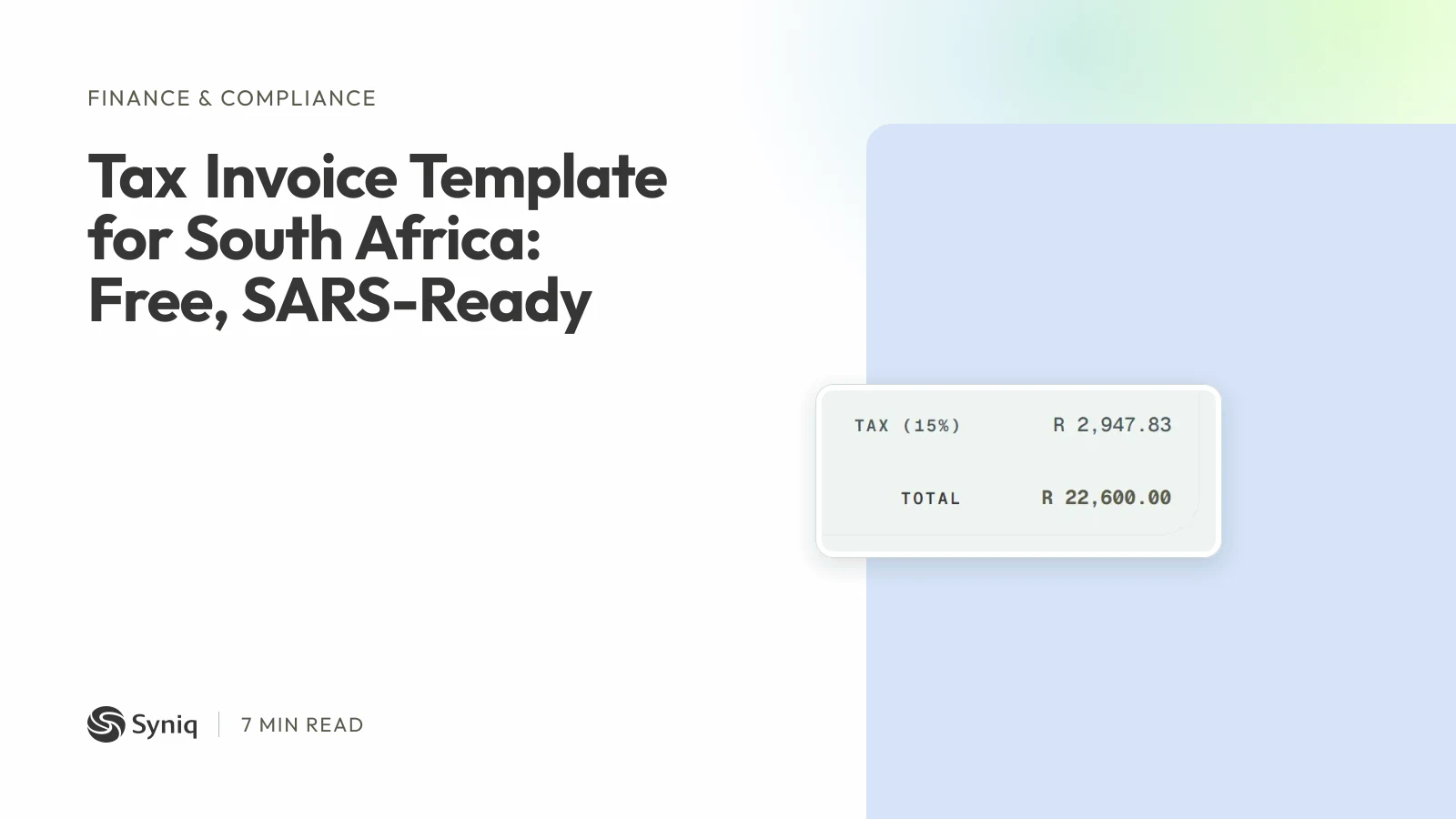
Only if you are registered for it. Since 1 April 2026, registration is compulsory once your taxable sales pass R 2.3 million in 12 months. You may register voluntarily from R 120,000. If you are not registered, you do not add VAT to your prices, and you cannot issue a tax invoice. Our guide to SARS and VAT rules for accounting software goes through what a registered business has to keep, and Tax Invoice Template for South Africa: Free, SARS-Ready shows how the VAT appears on an invoice.
What the tables and formulas do not cover
- They do not decide whether VAT applies. They only do the sum at 15%.
- They do not cover imports. Customs VAT on imported goods follows its own rules.
- They do not cover foreign currency. Convert to rands first.
- They are not tax advice. Check your own case with a registered accountant.
When a calculator is not enough
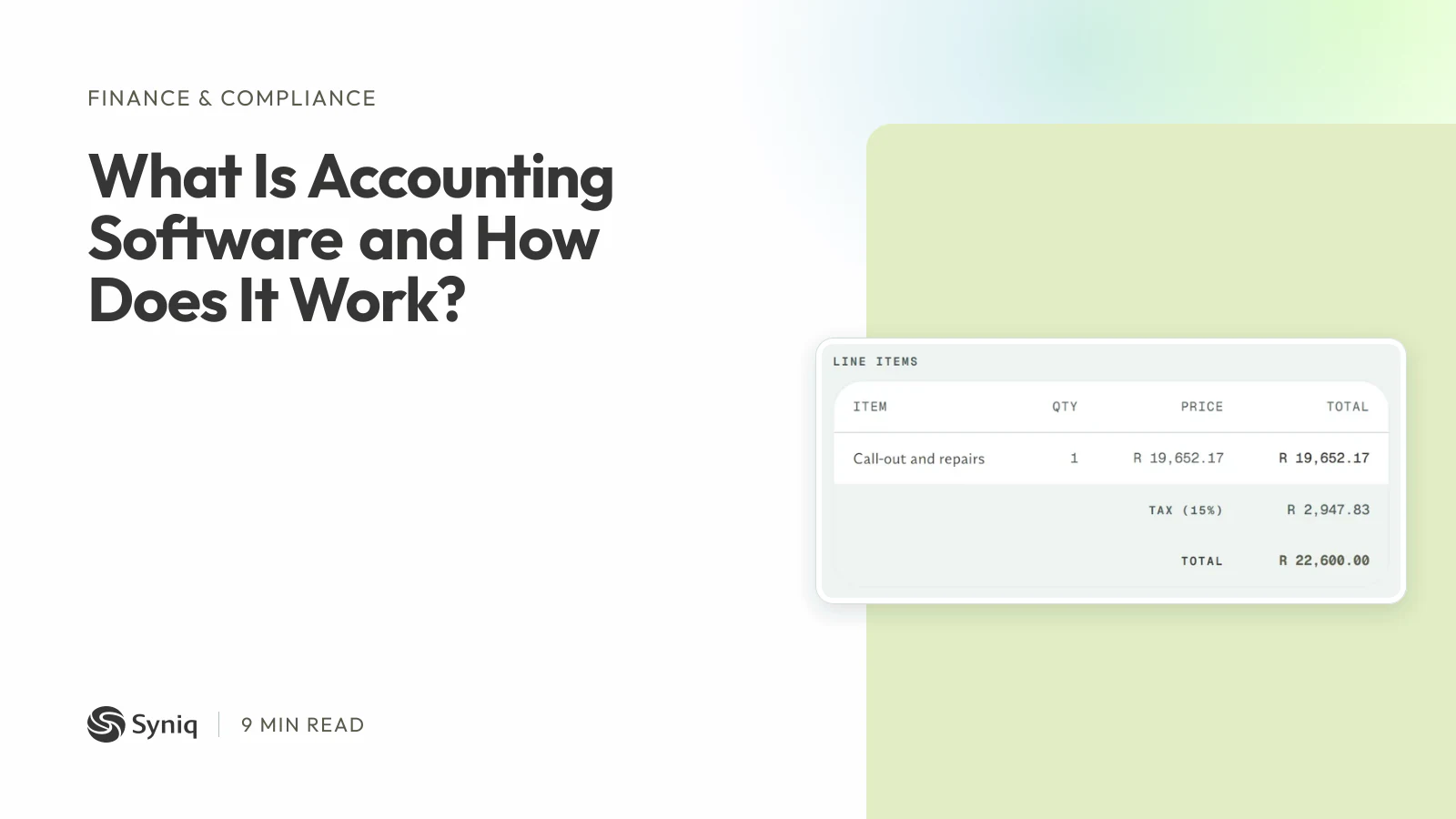
A calculator is fine for a quote or a spot check. Doing the sum on every line of every invoice is where mistakes appear: a total that does not agree with the lines, a price quoted with VAT that should have been without, or a missing VAT number. Our guide What Is Accounting Software and How Does It Work? explains the next step.
Where does Syniq fit?
Syniq Accounting is one of the six apps in Syniq Business OS. It does this sum for you:
- VAT is worked out on every line of an invoice, and each invoice carries your company, VAT and banking details.
- A VAT summary report sits with profit and loss, cash flow and aged receivables, in PDF or Excel, to hand to your accountant.
It is not a full accounting package. Syniq does not produce a balance sheet or trial balance. It has no payroll, no multi-currency invoicing and no live bank feeds, and it does not file VAT returns with SARS. Syniq is not VAT-registered, so it adds no VAT to its own prices.
Starter costs R 47 a month, billed annually, for one user and Accounting plus one other app. Professional costs R 159 for one user and all six apps, and Business costs R 559 for five users and all six apps. See every plan, or start a 14-day free trial with no credit card.
Frequently asked questions
How do I calculate VAT in South Africa?
To add VAT, multiply the price before VAT by 1.15. To take VAT out of a price that includes it, divide by 1.15. The standard rate is 15%. R 1,000 plus VAT is R 1,150, and R 1,150 less VAT is R 1,000.
How do I calculate VAT at 15% on a calculator?
Type the price before VAT, press ×, type 1.15 and press equals to get the total. To find the VAT alone, multiply by 0.15 instead. To remove VAT from a total, divide it by 1.15.
Why can't I just take 15% off a price that includes VAT?
The 15% is worked out on the price before VAT, so VAT is a smaller share of the total, about 13%. Taking 15% off R 1,150 leaves R 977.50, not R 1,000. Divide by 1.15 instead.
What is the VAT rate in South Africa?
The standard rate is 15%, charged by VAT-registered vendors. Some supplies are zero-rated (0%) or exempt. SARS lists them on its VAT pages.
Who must charge VAT?
VAT-registered vendors. Since 1 April 2026, registration is compulsory once taxable sales pass R 2.3 million in 12 months. Voluntary registration is open from R 120,000. Ask your accountant about your own position.
Does Syniq work out VAT for me?
Yes. Syniq Accounting works out VAT on every invoice line and gives you a VAT summary report. It does not file your VAT return with SARS, and Syniq is not VAT-registered itself, so it adds no VAT to its own prices.
Written by Mikhail for Syniq (Pty) Ltd, which makes Syniq Business OS. The VAT rate, thresholds and zero-rated and exempt wording are from SARS's VAT page, and the formulas match the QuickBooks South Africa and TaxTim calculator pages, all read on 15 November 2026. This is general information, not tax advice: ask a registered accountant about your own sales.