The best CRM for a digital marketing agency keeps the pitch, the retainer, the delivery hours and the invoice on one client record. Lists of agency CRMs are mostly about email tools and ad reporting, so first decide whether you want a marketing suite, a sales pipeline or a business suite. This guide covers what an agency needs, the kinds on offer, and how to choose one in South Africa.
Why agencies are not like other CRM buyers
A shop sells to a customer once. An agency sells a pitch, delivers for months, bills every month and then renews. The client record matters more than any single deal.
Capsule, a CRM vendor, makes the same point in its agency guide. It names five needs: a client-first structure instead of deal-first pipelines, depth in each relationship, awareness of campaigns and delivery, lightweight workflows, and reporting that clients care about (Capsule, opened 12 November 2026). HubSpot's agency guide adds integrations with invoicing and project tools, renewal reminders, and support for retainer and recurring revenue (HubSpot, opened 12 November 2026). Both are vendors, and each ranks its own product first, so weigh them as such. Neither mentions South Africa, rands or VAT.
Where agencies outgrow the spreadsheet
Most agencies begin with a sheet of leads, a folder of proposals and a chat group for delivery. It works until three things happen at once:
- Proposals go quiet. A pitch went out three weeks ago and nobody followed up.
- Retainers roll over unnoticed. A contract renews, or lapses, before anyone has checked the terms.
- Nobody knows who is doing what. Status lives in chat threads, so every client update starts with a round of questions.
What an agency should look for in a CRM
- A pipeline for pitches. Every pitch by stage, with its value, apart from work you already have.
- One record per client. The deals, the contacts, the jobs and the invoices in one place.
- Quotes on the deal. The proposal price should sit on the deal, not in a folder.
- Delivery tasks and hours. Someone has to see who is doing what, and how long it took.
- Retainers and renewals. A renewal date on every recurring contract, with a warning before it arrives.
- Margin you can see. Cost beside price on each quote and invoice, so a loss-making retainer shows up.
- Permissions for freelancers. A freelancer should see their own clients, not the whole book.
- Client reporting. Check whether clients can log in, or whether you send reports by hand.
- Marketing tools, if you want them inside. Email sending, landing pages and ad links are a product of their own. Decide if your CRM must have them.
- Accounting links and rand prices. Check which accounting package it connects to, and how VAT is shown.
The kinds of CRM agencies choose
| Type | What it is | Best for | Watch out for |
|---|---|---|---|
| Marketing-suite CRM | A CRM inside a platform for email, landing pages and ads | An agency that wants its own marketing tools in one product | Price rises with contacts and add-ons, and set-up takes time |
| Sales-pipeline CRM | A simple board of deals | A small agency that mainly needs to track pitches | Delivery, hours and invoices live elsewhere |
| Relationship CRM | A CRM built around the client and the conversation | An agency that sells on relationships | Quotes and billing are usually separate |
| Business suite with CRM | CRM, jobs and accounting on one record | An agency that wants the pitch, the job and the invoice together | Check the marketing tools: suites rarely replace a sending platform |
Whichever type you pick, ask for the price in rands, check how VAT is shown, and ask where support is based.
What it costs
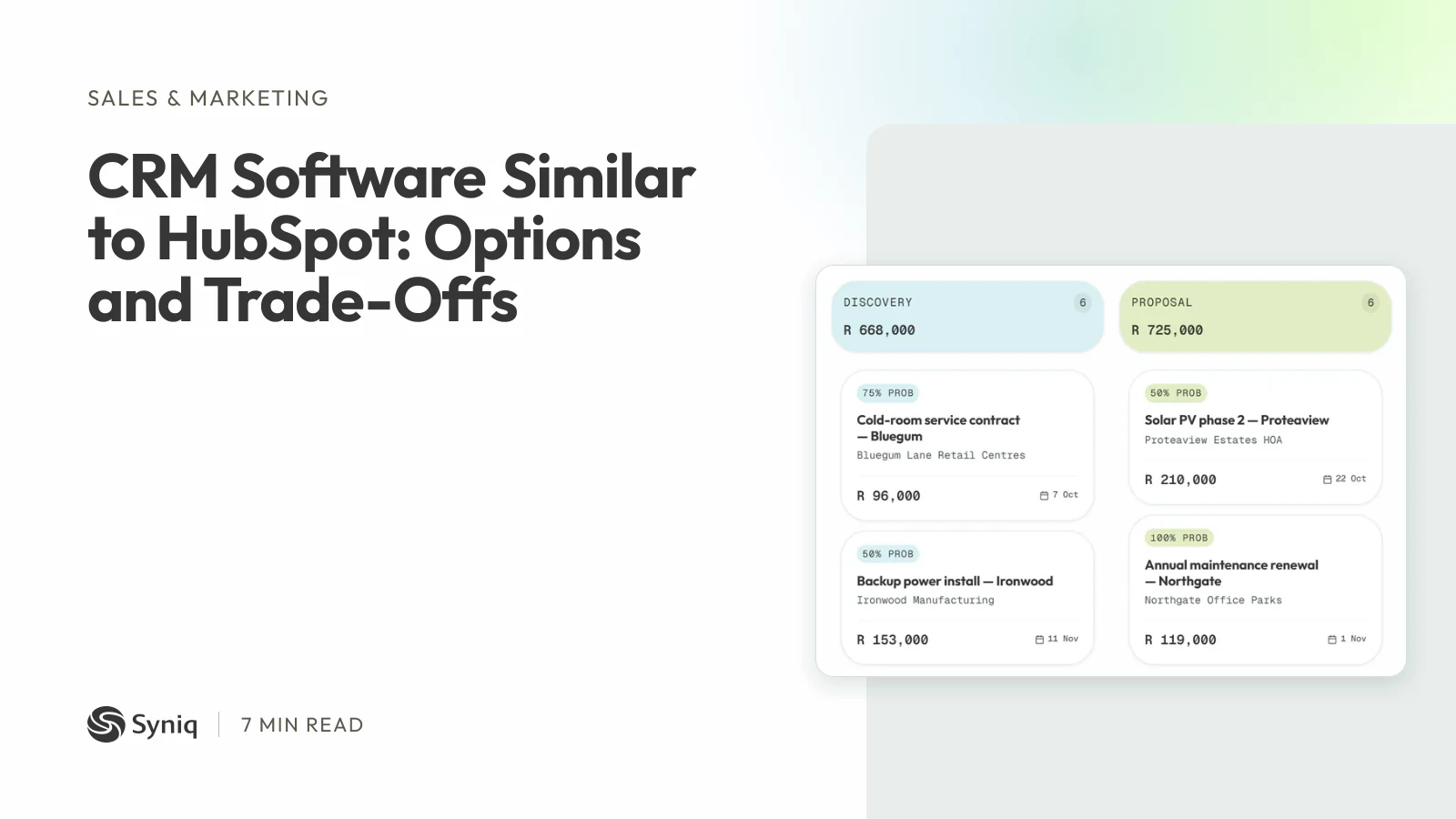
Many CRMs charge per user each month, and the price often rises as your contact list grows. How Much Does a CRM Cost in South Africa? (2026 Guide) breaks down what to expect, and Best CRM Software in South Africa for Small Business (2026) compares the options. If you are weighing a marketing suite, CRM Software Similar to HubSpot: Options and Trade-Offs covers that route.
Marketing software for agencies: do you need it in the CRM?
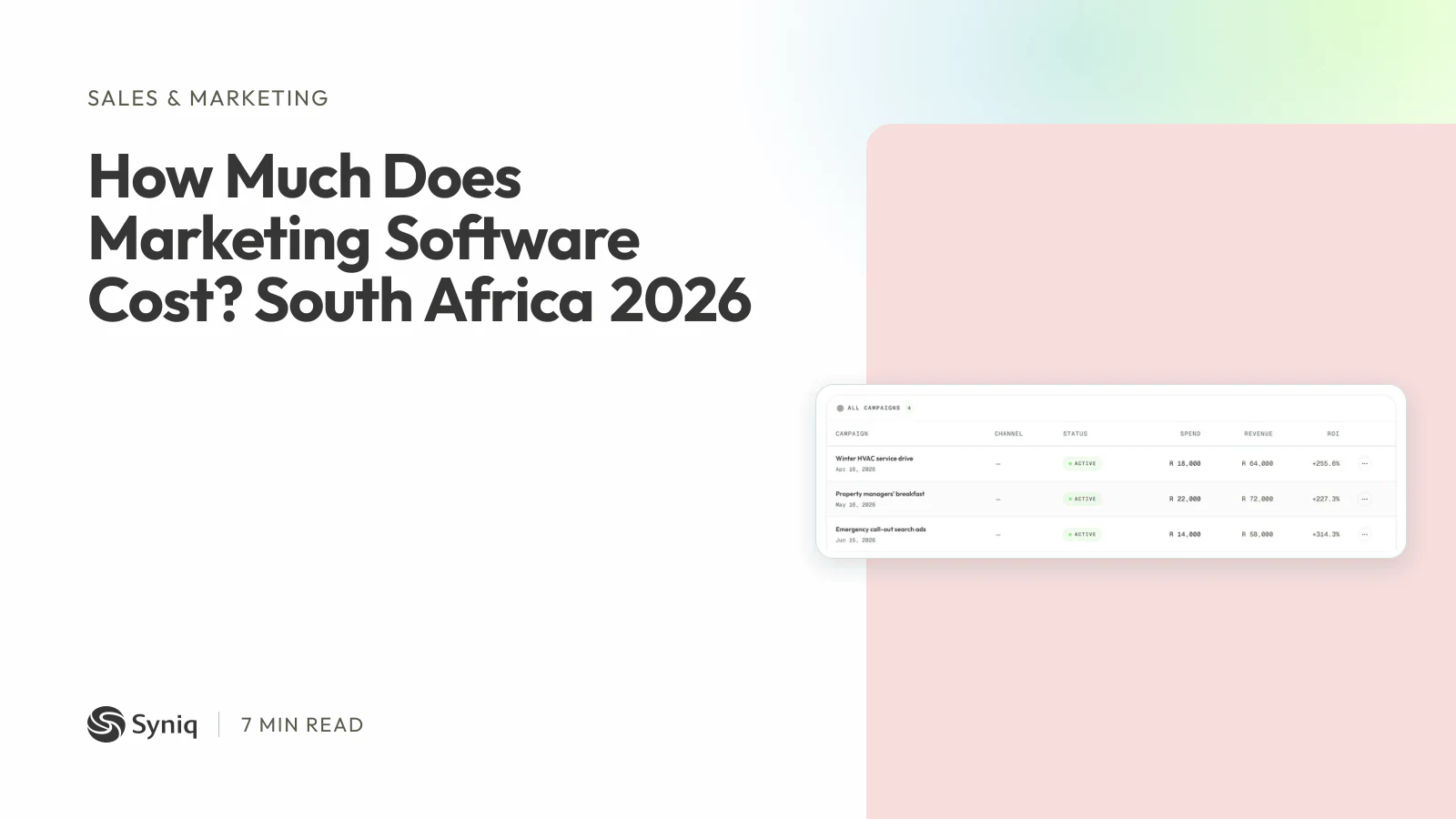
Many agencies already own sending and ad tools for their clients' campaigns. Paying for a second set inside the CRM adds cost and does little for the work. The CRM job is different: it tracks your own pipeline, your own leads and which of your own campaigns bring in clients. How Much Does Marketing Software Cost? South Africa 2026 shows what the sending side costs.
How agency work fits in Syniq
Syniq Business OS has six apps, and Sales is its CRM. For an agency the relevant parts are:
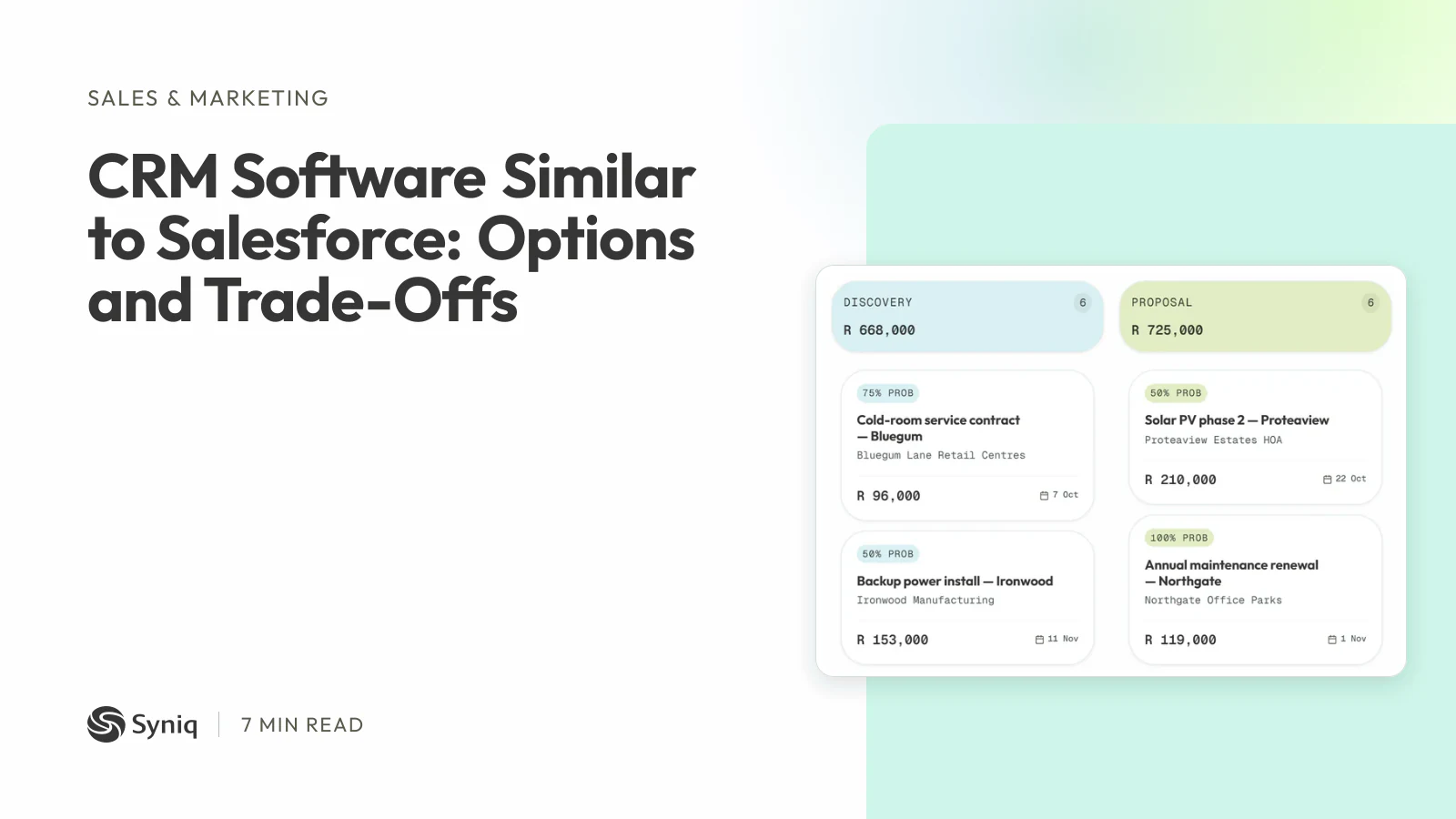
- A pipeline. Pitches move through stages you set, and each stage shows its deals and their value.
- Client profiles. Each client's deals, jobs, invoices, tickets and contacts sit on one profile.
- Quotes on the deal. Build the proposal as a quote. When it is accepted, the invoice is generated from its lines for sign-off. Quoting Software: What It Is and How to Choose One explains how that works.
- Jobs with tasks and hours. Operations plans each client project as a job, with tasks you assign and the hours logged against each one. Create the job straight from the won deal.
- Retainers and renewals. Set a renewal date and cadence on the job and follow it on the renewals board. Turn on auto-draft and the renewal quote is prepared 30 days ahead.
- Freelancer access. Give a freelancer a role with only the apps they need, and limit them to one business unit's records.
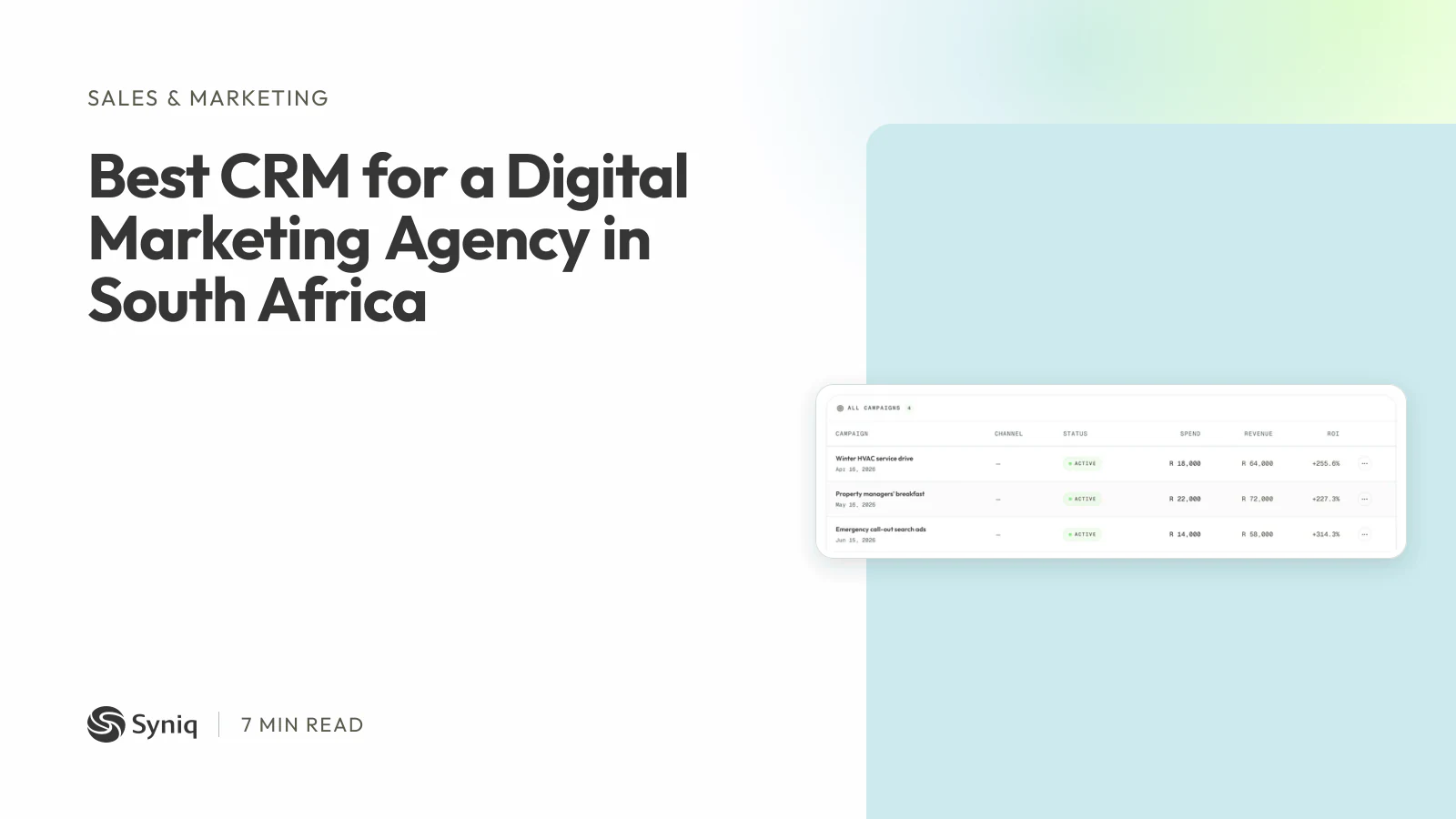
- Your own marketing. Marketing records each lead against the campaign that found it, and a won deal keeps that campaign, so you can see which campaigns bring in clients.
- QuickBooks Online. Customers, vendors, invoices, quotes and purchase orders sync both ways.
Starter costs R 47 a month, billed annually, for one user and any two apps. Professional costs R 159 for one user and all six apps. Business costs R 559 for five users and all six apps, and it adds role and business-unit permissions. Syniq is not VAT-registered, so no VAT is added.
It is not the right fit for everyone:
- Syniq has no client portal, so clients cannot log in to see progress.
- Syniq does not total margin per client. Each quote and invoice line can carry an internal cost, so each document shows its margin.
- Syniq has no email sending and no marketing automation, so it does not replace a sending platform.
- Syniq has no ad-platform links and no social publishing: the social planner plans posts, and you publish them.
- Syniq connects to QuickBooks Online, not to Xero or Sage.
- It has no features written only for agencies: the pipeline, the job and the renewals board are general tools that suit agency work.
If you want the pitch, the delivery and the invoice on one client record, see Syniq for agencies or start a 14-day free trial.
Before you choose
Run one real client through the tool you are considering. Add the client and two contacts, put the pitch on the board, build the quote, win it, create the job, log an hour and bill the first month. Then set the renewal date. The steps that need a workaround show you what the tool will cost you every week.