Marketing analytics software collects marketing data from your website, campaigns and sales, and turns it into reports that show what is working. For a small business the useful question is narrower: which campaigns brought in clients who paid. This guide sorts the tools into three kinds, lists the KPIs worth watching and says where Syniq Marketing fits.
Syniq wrote this guide and sells Syniq Business OS, whose Marketing app is a campaign and lead tracker, not a web analytics tool. It does not track website traffic. We name no other vendor's prices or features here; check each vendor's own page before you buy.
What marketing analytics software does
Whatever the label, these tools do three jobs:
- Collect. They gather numbers from the places you market: your website, social accounts, ad accounts, your lead list and your sales records.
- Combine. They put those numbers side by side, so you compare channels on the same page and period.
- Explain. They show trends and, in the better tools, trace revenue back to the campaign that earned it.
"Marketing reporting software" and "marketing KPI software" describe the same job from the reader's side: you want a short list of numbers, updated without you rebuilding a spreadsheet every month.
Three kinds of tool
| Kind | It answers | You need it when |
|---|---|---|
| Web and search analytics | Who visited, from where, and what they did on the site | Your website is where most leads start |
| Dashboard and reporting tools | How all channels did, pulled into one view | You run several channels and report to a boss or a client |
| Campaign and revenue tracking | Which campaign brought in leads that became paid work | You want to spend on what pays, not what gets clicks |
Many all-in-one marketing suites bundle some of the three. Most small businesses need the third kind first and add the first two as the budget allows.
KPIs a small business should watch
- Leads by source. Where each lead came from, with nothing left as "unknown".
- Cost per lead. What you spent on a campaign divided by the leads it produced.
- Lead-to-client rate. The share of leads that become paying clients. Count the leads and the clients before you quote a percentage; a handful of leads makes any percentage unreliable.
- Revenue by campaign. The value of won deals, grouped by the campaign that found the lead.
- Follow-up time. How long a new lead waits before anyone contacts them.
If a KPI changes no decision, drop it. The executive dashboard KPIs guide applies the same test to the whole business.
What Syniq Marketing does
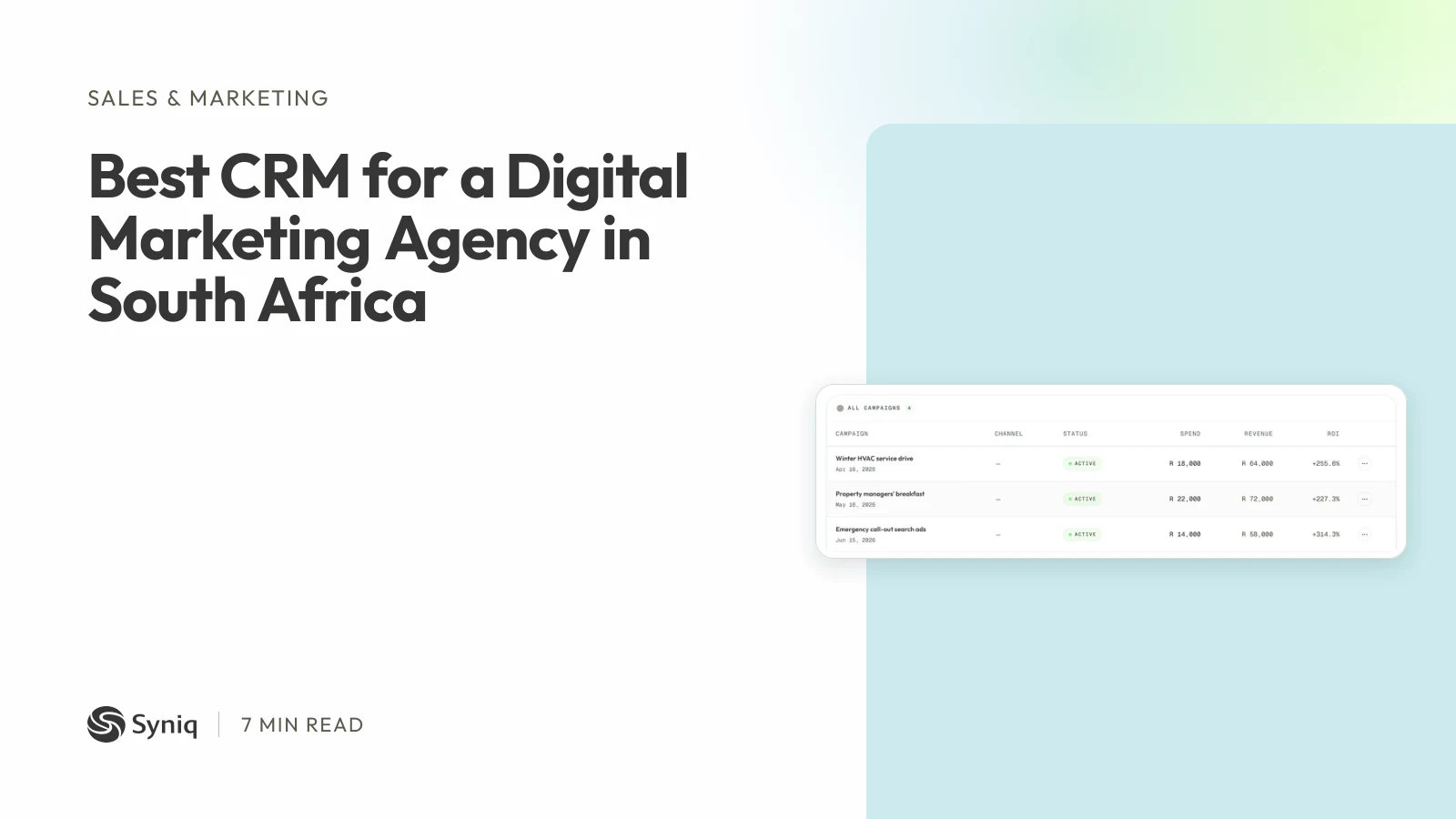
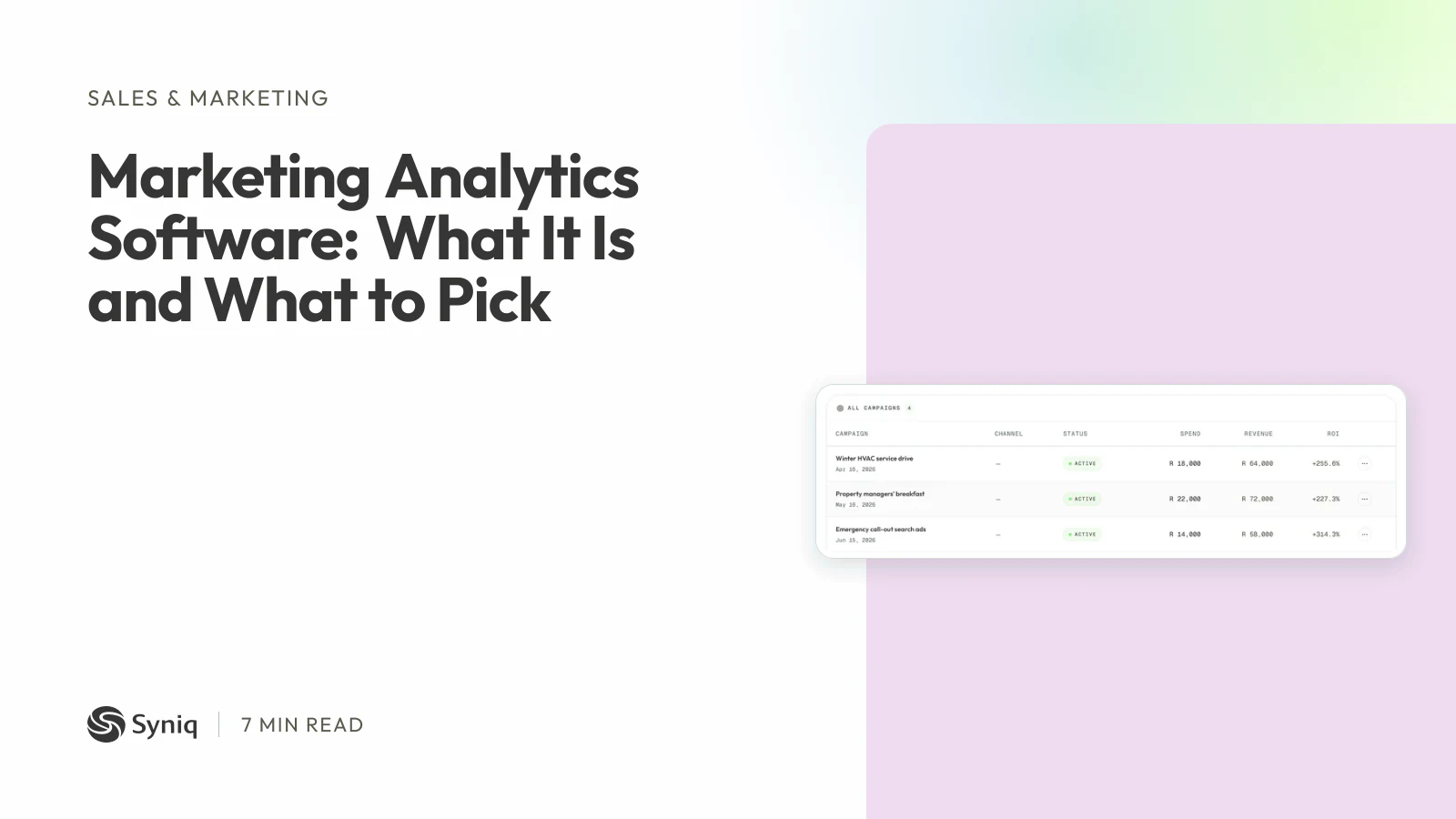
Syniq Marketing records each campaign with a channel, an objective, a budget and a start date, and holds social posts on a planning calendar. You capture each lead against the campaign that brought it in. When you convert the lead into a deal in Syniq Sales, the deal keeps its campaign, so its won value counts towards that campaign's revenue. Each lead scores out of 100 from its details, its status and its logged activity; the score is a fixed rule, not AI. Each morning the Marketing overview shows short cards about your own records, such as new leads and leads not contacted after two working days.
That covers leads by source, revenue by campaign and follow-up time from the list above. Because the leads, deals and invoices are in one system, there is nothing to export and re-import.
What Syniq Marketing does not do
- It does not track website visits, ad impressions or clicks.
- It does not send marketing email, SMS or WhatsApp messages, and it runs no automated workflows.
- It does not publish social posts. It plans them and your team publishes them.
- It shows only what your team records. A lead nobody tagged to a campaign has no campaign.
If you need traffic and search numbers, use a web analytics tool for that and keep Syniq for the question it answers: which campaigns pay. How Much Does Marketing Software Cost? South Africa 2026 shows what the sending side costs.
How to choose
- Write down the one question you cannot answer today, such as "which campaign made the money?"
- Match it to a kind in the table above.
- Check that the tool covers the channels you use and what it costs in rands each month.
- Test it with last month's real leads in a free trial. A report that needs retyping will not be used.
- Add a second tool only when the first one's gap costs you decisions.
Syniq's Starter plan is R 47 a month billed annually for one user and any two apps, such as Marketing and Sales. Syniq is not VAT-registered, so no VAT is added. Try it free for 14 days, or see every plan.
Frequently asked questions
What is marketing analytics software?
Software that collects marketing data, such as website visits, leads and sales, and turns it into reports on what works. Some tools measure traffic, some build dashboards from many sources, and some trace revenue back to the campaign that earned it.
What is the difference between marketing analytics and marketing reporting?
Reporting shows what happened: leads this month, revenue by channel. Analytics asks why and what to do next. In practice one tool usually does both, and a small business needs the reporting right first.
Which marketing KPIs should a small business track?
Start with leads by source, cost per lead, the share of leads that become clients, revenue by campaign and the time it takes to follow up a lead. Five numbers you act on beat thirty you only look at.
Does Syniq Marketing track website traffic?
No. Syniq Marketing records campaigns and leads and totals the won deals tagged to each campaign. It does not track website visits, ad impressions or clicks, and it sends no marketing email.
Can Syniq show which campaign made the money?
Yes, for deals your team records. A lead keeps its campaign, the deal it becomes keeps that campaign, and the won value counts towards that campaign's revenue.
Written by Mikhail for Syniq (Pty) Ltd, a Cape Town software company.